


how to use this devotional
Spiritual growth rarely happens by accident. Our prayer is that this devotional will help you move beyond simply knowing these stories to understanding them more deeply. As you spend time in God’s Word each day, ask the Holy Spirit to reveal His truth, strengthen your faith, and shape your life.
Each day includes:
Scripture — Begin by reading slowly and attentively.
Devotional — Reflect on how the passage speaks into your life.
Reflection — Invite God to search your heart honestly.
Prayer — Respond to Him personally.
Consider discussing what you are learning with your spouse, your family, or a friend. Spiritual conversations strengthen spiritual environments.
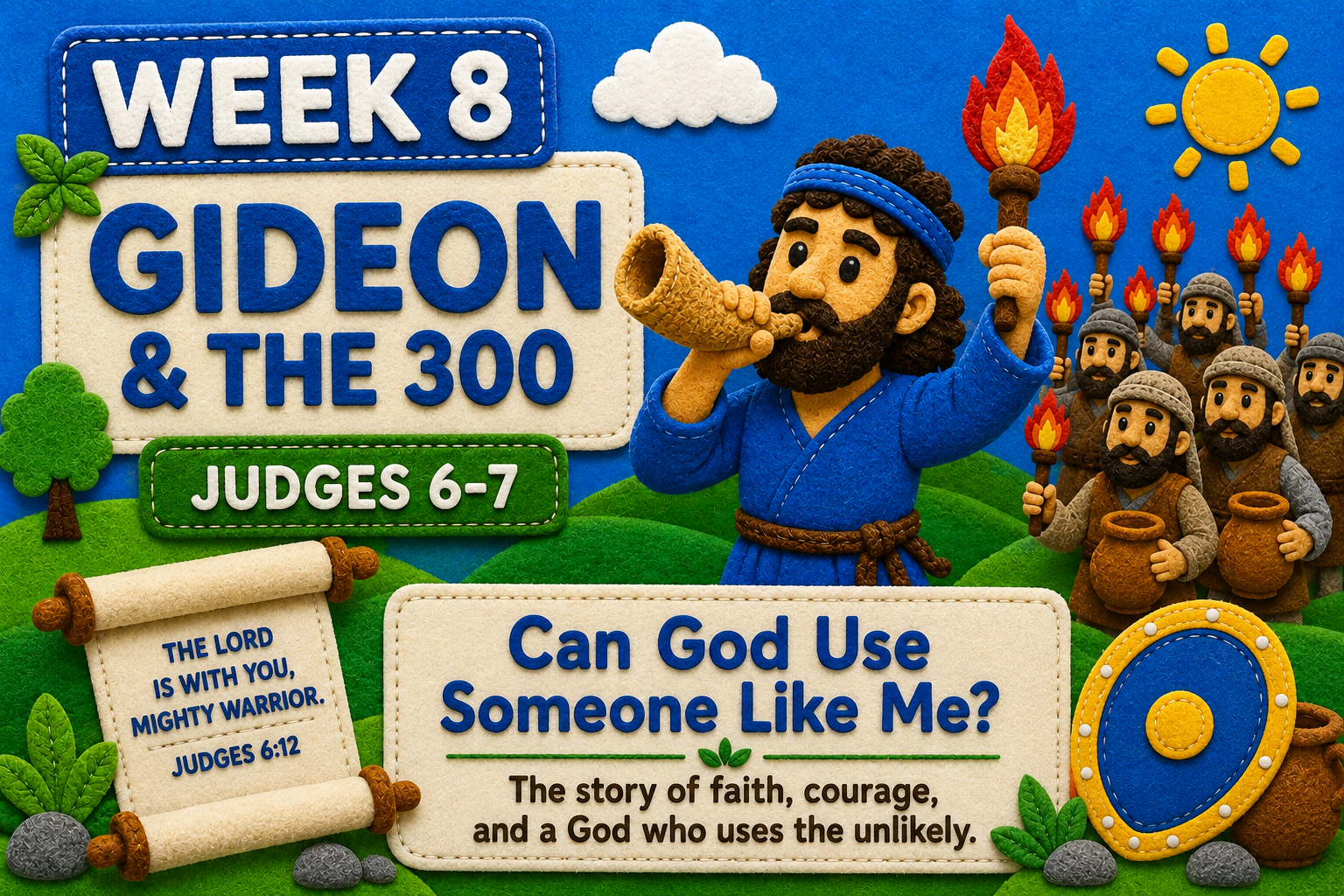
Week 8
Judges 6-7
-
Read: Judges 6:11–24
“The angel of the Lord appeared to him and said, ‘Mighty hero, the Lord is with you!’” — Judges 6:12 (NLT)
If someone were choosing Israel's next great leader, Gideon probably wouldn't have made the list. When we first meet him, he isn't leading an army—he's hiding. The Midianites had oppressed Israel for years, and Gideon was threshing wheat in a winepress so it would not be stolen. That is where God found him.
The angel of the Lord greeted Gideon with surprising words: "Mighty hero, the Lord is with you!" Gideon didn't feel like a hero. He immediately pointed to his weaknesses—his family, his position, and his own sense of inadequacy.
We often respond the same way. When God calls us to serve Him, we focus on what we lack instead of what He has promised. We compare ourselves to others and conclude that someone else would be better suited for the task.
But God saw Gideon differently.
His calling was never based on Gideon's ability. It rested on one promise: "I will be with you."
That promise runs throughout Scripture. God gave it to Moses, Joshua, and ultimately to every believer through Jesus: "I am with you always."
God has never asked His people to accomplish His work in their own strength. He supplies what He calls for.
Gideon's fears did not disappear overnight, but he learned to trust God's presence more than his own limitations. Courage is not the absence of fear—it is choosing to obey because God is faithful.
If you feel inadequate today, remember where Gideon's story began. An ordinary man hiding in a winepress became a mighty warrior because the Lord was with him. The same God is with you today.
Faith & Facts: Was the Angel of the Lord Really God?
In several Old Testament passages, the Angel of the Lord speaks and acts in ways that suggest more than an ordinary angel. Because Judges 6 moves naturally between "the Angel of the Lord" and "the Lord," many scholars understand this to be a pre-incarnate appearance of Christ.
Faithful Christians have held different views, but the central truth is clear: God Himself called Gideon and promised to be with him. Gideon's confidence rested not in himself, but in the One who called him.
Reflect
Where do you most often feel inadequate or unqualified?
How might your perspective change if you focused more on God's presence than your limitations?
What step of obedience is God inviting you to take today?
Prayer
Father, thank You that You see more in me than I can see in myself. Forgive me for allowing fear and insecurity to keep me from following You. Help me trust that Your presence is enough and that You will faithfully equip me for whatever You ask me to do. Give me courage to take the next step in obedience. In Jesus' name, amen.
-
Read: Judges 6:25–40
“Then Gideon said to God, ‘If You are truly going to use me to rescue Israel as You promised…’” — Judges 6:36 (NLT)
One reason Gideon's story is so encouraging is its honesty. After God called him to deliver Israel, Gideon didn't suddenly become fearless. He still wrestled with questions, and his faith was still growing.
Scripture reminds us that God often meets His people in the middle of their doubts. Abraham questioned God's promise of a son. Moses doubted his ability to lead. Jeremiah believed he was too young. Thomas struggled to believe until he saw the risen Christ.
God did not reject them because they had questions. He patiently taught them to trust Him. Before Gideon asked for the sign of the fleece, God had already been strengthening his faith. He instructed Gideon to tear down his father's altar to Baal and build an altar to the Lord. Gideon obeyed, even though he was afraid, carrying out the task at night.
That is an important lesson. Courage is not the absence of fear—it is obedience in the presence of fear.
Only afterward did Gideon ask God for confirmation. He was not seeking God's will—God had already revealed it. He was asking the Lord to strengthen his confidence before the battle ahead, and God graciously met him where he was.
Faith rarely grows by having every question answered in advance. More often, God gives us enough light for the next step and invites us to trust Him with the rest.
If you're wrestling with doubts today, bring them honestly to the Lord. Search His Word, pray faithfully, and seek wise counsel. But don't allow unanswered questions to keep you from obeying what God has already made clear. Faith is not knowing everything. It is trusting the One who does.
Faith & Facts: Should Christians "Put Out a Fleece"?
Although God graciously answered Gideon's request, the fleece was never intended to become the normal pattern for discovering God's will.
Today, God primarily guides His people through His Word, the Holy Spirit, and the wisdom of mature believers. The lesson of Judges 6 is not to seek miraculous signs, but to trust that God patiently strengthens the faith of those who sincerely seek Him.
Reflect
What questions or doubts have you been bringing before the Lord?
Is there an area where God has already made His will clear, but you have been waiting for more confirmation?
How has God patiently strengthened your faith over the years?
Prayer
Father, thank You for Your patience with me. Help me bring my questions honestly before You while trusting what You have already revealed in Your Word. Strengthen my faith as I walk with You, and give me courage to obey even when I cannot see the entire path ahead. In Jesus' name, amen. -
Read: Judges 7:1–15
“The Lord said to Gideon, ‘You have too many warriors with you.’” Judges 7:2 (NLT)
If you were preparing for a battle, reducing the size of your army would probably be the last thing you would do. Yet that is exactly what God told Gideon to do.
When Gideon gathered the men of Israel, more than thirty thousand soldiers answered the call. Even that number was far smaller than the Midianite army they would face, but it was a promising beginning. Then God spoke words that must have left Gideon completely confused: “You have too many warriors with you.”
From a military standpoint, that statement made no sense. Israel was already badly outnumbered. Why would God send thousands of soldiers home before the battle had even begun?
The answer reveals something important about the heart of God.
The Lord knew that if Israel won with a large army, the people would be tempted to believe they had accomplished the victory through their own strength. They would celebrate their strategy, their courage, and their skill instead of recognizing that the victory belonged to Him. God wasn’t simply preparing Israel to win a battle. He was teaching His people to trust Him.
By the end of God’s instructions, only three hundred men remained.
Imagine what Gideon must have been thinking as he watched soldier after soldier return home. Every reduction made victory seem less likely. Yet with every soldier who left, Gideon had one less reason to depend on human strength and one more reason to depend on God.
That is often how the Lord works in our lives.
We naturally ask God to give us more. More resources. More opportunities. More strength. More certainty. More control. Sometimes He does. But there are also times when He lovingly removes the very things we have come to rely upon because He wants us to discover that He is enough.
Those seasons can feel unsettling. We may lose a position we valued, a relationship we depended upon, or a plan we carefully built. At first, it seems as though God is taking something important away from us. Later, we often discover that He was making room for a deeper dependence on Him.
The apostle Paul learned that lesson firsthand. Three times he pleaded with the Lord to remove what he called his “thorn in the flesh.” Instead of removing it, God replied, “My grace is all you need. My power works best in weakness” (2 Corinthians 12:9). Paul eventually realized that his weakness had become the place where God’s strength was most clearly displayed.
None of us enjoys feeling inadequate. We would much rather feel strong, capable, and self-sufficient. Yet the Christian life was never designed to be lived independently of God. From beginning to end, it is a life of dependence.
Gideon entered the battle with fewer soldiers than he wanted, but he also entered it with a clearer understanding of who would win the victory.
Sometimes God’s greatest gifts come wrapped in smaller numbers, weaker circumstances, and greater dependence.
When He becomes all we have, we often discover that He is all we have ever needed.
Faith & Facts: Why Did God Reduce Gideon’s Army?
God explains His reason plainly in Judges 7:2: “If I let all of you fight the Midianites, the Israelites will boast to me that they saved themselves by their own strength.”
The reduction of the army was not a military strategy. It was a spiritual lesson. God intentionally arranged the situation so that His people would recognize that the victory belonged to Him alone.
Throughout Scripture, God often chooses what appears weak in the eyes of the world so that His power and glory become unmistakable (see 1 Corinthians 1:27–29).
Reflect
· Are there areas of your life where you’ve been depending more on your own strength than on God?
· Has there been a season when God removed something you thought you couldn’t live without, only to show you His faithfulness in a deeper way?
· How might God be inviting you to trust Him more fully today?
Prayer
Father, I confess that I often feel more secure when I can rely on my own abilities instead of depending on You. Thank You for loving me enough to teach me that Your strength is greater than mine. Help me trust You when You remove the things that make me feel secure, knowing that You are always working for my good and Your glory. Teach me to find my confidence in Your presence rather than in my own resources. In Jesus’ name, amen. -
Read: Judges 7:16–25
“When I come to the edge of the camp, do just as I do.” Judges 7:17 (NLT)
By the time Gideon and his three hundred men reached the edge of the Midianite camp, they still had not drawn a single sword. Instead, each man carried a trumpet, an empty clay jar, and a torch hidden inside the jar. If victory depended on military strategy alone, this plan seemed destined to fail.
At Gideon’s signal, the men blew their trumpets, smashed their jars, lifted their torches into the night, and shouted, “A sword for the Lord and for Gideon!” The sudden noise and light threw the Midianite camp into confusion. In the darkness, the soldiers turned on one another, and the enemy army fled in panic. The battle was won in a way no one could have anticipated.
It is hard to imagine anyone leaving that battlefield believing Israel had won because of superior planning or greater strength. God had arranged the victory so that His power would be unmistakable. The only reasonable explanation was that the Lord had fought for His people.
The Christian life often unfolds in much the same way. We naturally assume that if God is at work, He will do things in ways that make sense to us. We expect Him to choose the quickest path, the strongest people, and the most obvious solutions. Yet throughout Scripture, God repeatedly accomplishes His purposes through methods that surprise us. He chooses a shepherd boy instead of a king, a frightened judge instead of a seasoned warrior, fishermen instead of scholars, and ultimately a cross instead of a throne.
That doesn’t mean God delights in confusing us. It means His wisdom is infinitely greater than ours. He sees the beginning and the end at the same time, while we can only see the next step. What appears foolish from our perspective may be the very means by which God intends to display His glory.
Isaiah captured this truth when he wrote, “My thoughts are nothing like your thoughts… and My ways are far beyond anything you could imagine” (Isaiah 55:8–9). Those words remind us that faith is not simply believing God can do what we expect. Faith is trusting Him even when He chooses a path we never would have imagined.
Most of us can look back over our lives and identify moments when God’s plan unfolded differently than we had hoped. At the time, we struggled to understand why He allowed certain disappointments or redirected our plans. Yet with the benefit of hindsight, we often discover that His way proved wiser than our own.
Gideon learned that victory belonged to the Lord long before the battle ended. His role was simply to obey what God had asked him to do and trust Him with the results.
That remains our calling as well. We are responsible for obedience. God is responsible for the outcome. When we leave the results in His hands, we discover that His ways are always wiser than our own.
Faith & Facts: Why Trumpets, Jars, and Torches?
In the ancient world, a trumpet was typically carried by an officer, not by every soldier. A large army might have only a few hundred trumpeters. When the Midianites suddenly heard three hundred trumpets surrounding their camp in the middle of the night, they likely assumed they were facing an enormous force. The breaking jars exposed the torches all at once, creating confusion and panic throughout the camp.
God used ordinary objects to accomplish an extraordinary victory. The strategy reflected both practical wisdom and divine intervention, reminding Israel that their confidence belonged in the Lord rather than in conventional military strength.
Reflect
· Has God ever answered a prayer in a way you did not expect?
· Are you willing to trust God’s wisdom even when His plans differ from your own?
· What step of obedience is God asking you to take before you can see the outcome?
Prayer
Father, thank You that Your wisdom is perfect, even when I cannot understand what You are doing. Forgive me for the times I have insisted that You work according to my plans instead of trusting Your greater purposes. Help me obey You faithfully, leaving the results in Your hands. Give me confidence that Your ways are always good because Your character is always good. In Jesus’ name, amen. -
Read: Judges 8:22–28; 2 Corinthians 12:9–10
"My grace is all you need. My power works best in weakness." 2 Corinthians 12:9 (NLT)
As Gideon's story comes to a close, Israel wanted to make him their king. After years of oppression, the people naturally wanted the man God had used to lead them to continue ruling over them.
Gideon gave the right answer. He refused the crown and reminded the people that the Lord alone was their true King. The victory had never belonged to Gideon. It belonged to God.
Yet the story does not end as neatly as we might expect. In the verses that follow, Gideon made decisions that became a stumbling block for both himself and the nation. Although God used him in remarkable ways, Gideon remained an imperfect man. Like every leader in the Old Testament, he reminds us that no human deliverer is enough.
That is one of the reasons Scripture is so honest about its heroes. Abraham doubted. Moses lost his temper. David committed grievous sin. Gideon finished well in some ways and poorly in others. The Bible never invites us to place our hope in its human characters. Instead, each one points us to Someone greater.
Jesus is the true Deliverer Gideon could never be. Gideon rescued Israel from an earthly enemy for a season. Jesus came to rescue us from sin and death forever. Unlike every earthly leader, He never failed, never sinned, and never left His work unfinished. His victory is perfect, complete, and eternal.
That truth also reshapes the way we view our own lives. Gideon began as a fearful man hiding in a winepress. God did not choose him because he was strong or impressive but because He delights in displaying His power through people who depend on Him.
The apostle Paul learned the same lesson centuries later. When he pleaded for God to remove his weakness, the Lord answered, "My grace is all you need. My power works best in weakness." Our greatest qualification for serving God is not our strength but our dependence on Him.
Over the past eight weeks, we have seen that truth repeated again and again. God delights in using ordinary people to accomplish His extraordinary purposes. Yet every story ultimately points beyond its human hero to Jesus Christ. He is the promised Redeemer, the greater Ark, the better Jonah, the greater David, the faithful Daniel, the greater Esther, the true Joseph, and the perfect Deliverer. From Genesis to Revelation, the Bible tells one story—God's plan to rescue sinners through His Son.
Faith & Facts: Why Does the Bible Include the Failures of Its Heroes?
Ancient cultures often celebrated their leaders while hiding their weaknesses. The Bible does the opposite. It records the failures of its greatest figures with remarkable honesty because the story of Scripture has never been about extraordinary people. It is about an extraordinary God who accomplishes His purposes through imperfect people and ultimately through His perfect Son.
Reflect
Which story in this series has most strengthened your faith?
What have you learned about God's character over the past eight weeks?
How is Jesus inviting you to take your next step of faith?
Prayer
Father, thank You for revealing Yourself through the pages of Scripture. Thank You that every story points beyond human heroes to Jesus Christ, the perfect Savior. Help me depend on Your strength rather than my own, and give me the faith to follow You each day with confidence and humility. May my life reflect Your grace and bring glory to Your name. In Jesus' name, amen.
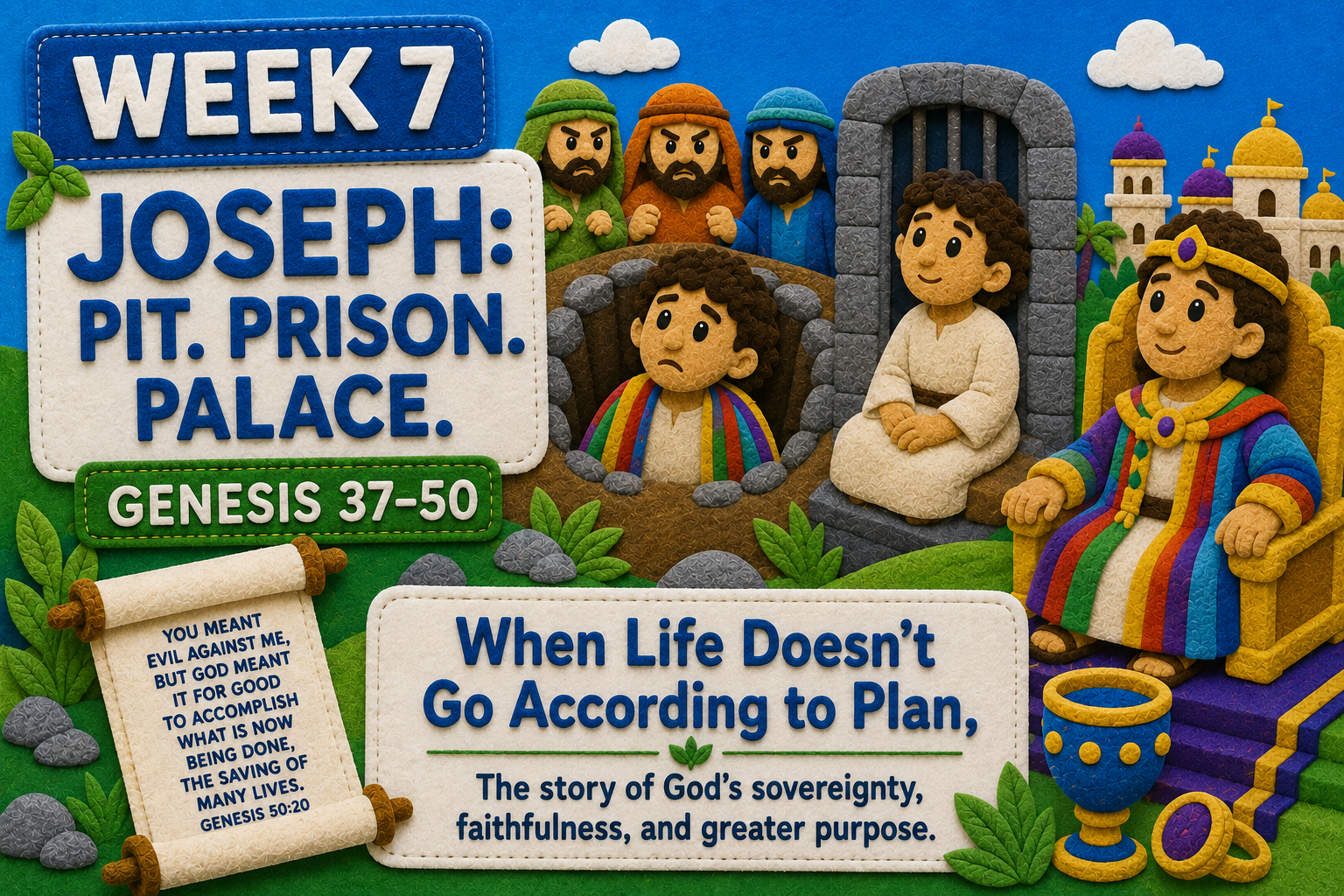
Week 7
Genesis 37-50
-
Read: Genesis 37:1–11, 18–28
"So when Joseph arrived, his brothers ripped off the beautiful robe he was wearing. Then they grabbed him and threw him into the cistern." — Genesis 37:23–24 (NLT)
Few stories in Scripture are as honest about suffering as the life of Joseph. His story begins not with triumph, but with betrayal.
Joseph was Jacob's favored son. God had given him dreams that pointed to a remarkable future, yet before those dreams came to pass, everything seemed to fall apart. His brothers stripped him of his robe, threw him into a cistern, and sold him into slavery.
Nothing about Joseph's circumstances suggested that God was fulfilling His promises. From a human perspective, they seemed to suggest the opposite.
We all experience seasons when life doesn't unfold the way we expected. Plans fall apart. Relationships end. Careers change. Illness interrupts our future. In those moments, it's easy to wonder where God is.
Joseph's story reminds us that God's purposes are not limited by our circumstances. The pit was not proof that God had abandoned Joseph. It was the beginning of a plan Joseph could not yet see.
The same is true for us. We often judge God's faithfulness by what we can see, but His presence is not determined by our circumstances. He is just as faithful in the pit as He is in the palace.
We may not understand where the road is leading, but we can trust the God who sees the end from the beginning. Even when our plans fall apart, His purposes remain secure.
Faith & Facts: Did God Cause Joseph's Brothers to Sin?
The Bible teaches that Joseph's brothers were fully responsible for their sinful choices. They acted out of jealousy and hatred, and God did not approve of their actions.
Yet God's sovereignty was greater than their evil. Years later Joseph declared, "You intended to harm me, but God intended it all for good" (Genesis 50:20). God did not cause their sin, but He used it to accomplish His saving purposes.
Reflect
Have you experienced a season when life turned out differently than you expected?
What circumstances are tempting you to question God's goodness today?
How does Joseph's story encourage you to trust God before you can see the ending?
Prayer
Father, when my plans fall apart, help me remember that Your purposes have not. Give me faith to trust You even when I cannot see the whole picture. Thank You that You are present in every season of life and that nothing can prevent You from accomplishing Your good purposes. In Jesus' name, amen. -
Read: Genesis 39:1–10
"The Lord was with Joseph, so he succeeded in everything he did as he served in the home of his Egyptian master." — Genesis 39:2 (NLT)
After being betrayed by his brothers, Joseph wasn't rescued. Instead, he was taken to Egypt and sold again, this time to Potiphar, an officer in Pharaoh's court.
From every outward appearance, Joseph's situation had only become worse. He was far from home, living as a slave in a foreign land. Nothing about his circumstances reflected the dreams God had given him.
Then Genesis gives us four life-changing words: "The Lord was with Joseph."
That statement is repeated throughout the chapter because it is the central lesson. God's presence is not measured by our circumstances. Joseph had not been abandoned in the pit, and he had not been abandoned in Potiphar's house.
Rather than becoming bitter, Joseph faithfully served where God had placed him. He didn't wait for better circumstances before honoring the Lord. He was faithful in the assignment right in front of him.
We often do the opposite. We tell ourselves we'll serve God more fully when life becomes easier or our circumstances improve. Joseph reminds us that faithfulness always begins where we are.
Whether life is joyful or difficult, God's call remains the same: trust Him, obey Him, and leave the results in His hands.
If you belong to Christ, the same promise that sustained Joseph belongs to you. The Lord is with you. His presence has not changed, His promises have not failed, and His plans are still unfolding.
Faith & Facts: Was Joseph Really a Historical Person?
The Bible consistently presents Joseph as a real historical figure. His story reflects accurate knowledge of ancient Egyptian culture and government, and later writers such as Stephen (Acts 7) and the author of Hebrews (11:22) treat him as an actual person in God's redemptive history.
Joseph's life is more than an inspiring story. It demonstrates God's faithfulness in preserving His covenant people.
Reflect
Have you ever questioned God's presence because of your circumstances?
Where has God placed you today that requires faithful obedience?
How would your perspective change if you believed God is just as present in difficult seasons as He is in joyful ones?
Prayer
Father, thank You for Your promise never to leave or forsake me. Forgive me for doubting Your presence when life becomes difficult. Help me trust that You are working even when I cannot see the whole picture, and teach me to be faithful where You have placed me today. In Jesus' name, amen. -
Read: Genesis 39:6–23
“How could I do such a wicked thing? It would be a great sin against God.” Genesis 39:9
Just when it seemed Joseph’s life was beginning to stabilize, another trial emerged.
Potiphar had entrusted his entire household to Joseph because he recognized his character and ability. Joseph had earned the respect of those around him, and everything he touched seemed to prosper. Then Potiphar’s wife began trying to seduce him. Day after day she urged Joseph to compromise, believing that no one would ever know.
Joseph’s response reveals what mattered most to him.
He didn’t begin by talking about the consequences if they were caught. He didn’t mention what it might do to his reputation or career. Instead, he asked a different question: “How could I do such a wicked thing? It would be a great sin against God.” That statement reaches the heart of biblical integrity.
Integrity is not simply doing the right thing because someone is watching. It is choosing to honor God because we know He is always present. Joseph understood that even if no one else ever discovered the truth, nothing is hidden from the Lord.
Our culture often defines integrity by outward appearance. As long as we maintain a respectable image, we assume everything is fine. Scripture takes us much deeper. God is concerned not only with what we do publicly but also with the attitudes, motives, and decisions that shape our private lives. Character is formed long before it is revealed.
Joseph’s decision also reminds us that temptation is rarely a one-time event. Genesis tells us that Potiphar’s wife approached him day after day. The pressure was constant. Joseph didn’t resist temptation once and then move on with his life. He chose faithfulness repeatedly, one day at a time. That is how integrity is built.
It grows through thousands of ordinary decisions to honor God when compromise would be easier. Most of those decisions are unseen by everyone except the Lord. Yet those hidden moments shape the kind of people we become.
Ironically, Joseph’s obedience did not produce the outcome we might expect. Potiphar’s wife falsely accused him, and Joseph was thrown into prison. From a human perspective, it looked as though integrity had cost him everything.
There are moments when following Christ carries a price. Doing what is right may cost us opportunities, relationships, popularity, or comfort. We should never assume that obedience guarantees immediate success. Sometimes faithfulness leads to misunderstanding before it leads to blessing.
But Joseph’s story reminds us that our responsibility is not to control the outcome. It is to remain faithful to God.
The Lord who was with Joseph in Potiphar’s house would also be with him in prison. His circumstances changed, but God’s presence did not. The same is true for us. When we choose integrity, we can trust that our lives are safely in the hands of the One who sees every hidden act of faithfulness and never forgets those who honor Him.
Faith & Facts: Why Didn’t God Keep Joseph Out of Prison?
It’s a question many people ask. If Joseph obeyed God, why did God allow him to be falsely accused?
The Bible doesn’t suggest that Joseph’s imprisonment was a sign of God’s displeasure. In fact, Genesis 39 repeats the same truth it proclaimed before Joseph was arrested: “The Lord was with Joseph.” God’s presence did not prevent suffering, but it transformed it.
Throughout Scripture, God often accomplishes His greatest purposes through seasons that appear unfair. Joseph could not see it at the time, but the prison would become the place where God positioned him for the future He had planned all along.
Reflect
· What does integrity look like in your daily life?
· Are there areas where you’re more concerned about appearances than about honoring God?
· How does Joseph’s example encourage you to remain faithful even when obedience is costly?
Prayer
Father, thank You that You see every part of my life, even the moments no one else notices. Help me love You more than I love the approval of others. Give me the strength to choose integrity when temptation comes and the courage to remain faithful even when doing what is right is difficult. Shape my character so that my private life reflects the same devotion to You as my public life. In Jesus’ name, amen. -
Read: Genesis 40:1–23; 41:1–16
“Two full years later…” Genesis 41:1 (NLT)
Few phrases in Scripture capture the pain of waiting quite like the opening words of Genesis 41: “Two full years later.”
Those words come after Joseph had faithfully interpreted the dreams of Pharaoh’s cupbearer and baker while they were imprisoned together. Before the cupbearer was released, Joseph made one simple request. “Please remember me and do me a favor when things go well for you. Mention me to Pharaoh so he might let me out of this place.”
It seemed like the answer to Joseph’s prayers had finally arrived. But it wasn’t. The cupbearer returned to Pharaoh’s service, resumed his normal life, and forgot all about Joseph. Days turned into weeks. Weeks became months. Months became years. Joseph remained in prison, and there is no indication that he understood why.
Most of us know what it feels like to live through a season like that. We pray faithfully, we try to do what is right, and we wait for God to act. At first we expect the answer to come quickly. Then the waiting stretches on, and we begin to wonder if God has forgotten us.
Joseph’s story reminds us that God’s delays are not the same as God’s absence.
From Joseph’s perspective, those two years may have seemed like wasted time. But from God’s perspective, they were part of His perfect timing. Pharaoh had not yet experienced the dreams that would bring Joseph before him. The nation was not yet ready for the wisdom God had given His servant. What felt like an unnecessary delay was actually divine preparation.
That truth is difficult to embrace because we naturally measure time differently than God does. We focus on what we want Him to do today. God is preparing us for what He intends to do tomorrow.
Waiting has a way of exposing what we truly believe about God. It reveals whether our confidence rests in His promises or in our preferred timetable. It teaches us to trust His wisdom when we cannot trace His hand.
The remarkable thing about Joseph is that Scripture gives no indication that he became bitter during those forgotten years. When Pharaoh finally called for him, Joseph was ready. He had not allowed disappointment to harden his heart or extinguish his faith. The years in prison had not been empty years. God had been shaping Joseph’s character long before He changed Joseph’s circumstances.
That is often how the Lord works in our own lives. We usually ask God to change our situation as quickly as possible. Sometimes He does. Other times, He chooses to change us while we are waiting. Patience, humility, perseverance, and deeper trust are rarely formed in moments of instant success. They grow quietly over time as we continue walking with God, even when we cannot see what He is doing.
If you find yourself in a season of waiting today, remember that your life has not been placed on hold. God is still at work. Every prayer He hears, every tear He sees, and every day that feels unnoticed is being woven into His larger purpose. His timing has never been early, and it has never been late.
When the moment was right, Pharaoh called for Joseph. Not a day before. Not a day after. And when God opened the door, no one could close it.
Faith & Facts: Why Did God Wait Two More Years?
The Bible never tells us why Joseph remained in prison for exactly two additional years. What it does show is that God’s timing was perfectly connected to Pharaoh’s dreams. Had Joseph been released earlier, he would likely have returned home instead of standing before the most powerful ruler in Egypt at precisely the right moment.
Scripture consistently teaches that God works according to His own wisdom and timing. What appears to us as delay is often preparation for something we cannot yet see.
Reflect
· Where are you experiencing a season of waiting?
· How has God used past seasons of waiting to shape your faith and character?
· What would it look like to trust God’s timing instead of demanding your own?
Prayer
Father, waiting is often difficult because I want answers on my schedule rather than Yours. Help me trust that You are never late and that You are always working for my good and Your glory. Give me patience when I grow discouraged and faith when I cannot see what lies ahead. Shape my heart during this season so that I become more like Christ while I wait. In Jesus’ name, amen. -
Read: Genesis 50:15–21
“You intended to harm me, but God intended it all for good. He brought me to this position so I could save the lives of many people.” Genesis 50:20 (NLT)
Joseph’s story ends where it began—with his brothers.
Years had passed since they threw him into the pit. Joseph had become the governor of Egypt, the famine had spread across the region, and the very brothers who once sold him into slavery had unknowingly come to him for food. Through a series of emotional encounters, Joseph revealed his identity, forgave his brothers, and welcomed his family to Egypt.
After their father Jacob died, Joseph’s brothers became afraid once again. They wondered if Joseph had only treated them kindly out of respect for their father. Now that Jacob was gone, they feared revenge.
Joseph’s response is one of the most beautiful expressions of grace in all of Scripture.
He did not deny what his brothers had done. He did not pretend that their betrayal was insignificant. He acknowledged their intentions honestly: “You intended to harm me.” What they did was real. It was sinful. It caused years of pain that could never be erased.
Then Joseph made a remarkable statement: “But God intended it all for good.”
Notice carefully what Joseph did not say. He did not say that evil became good. He did not say that God approved of his brothers’ actions. He did not suggest that suffering is somehow pleasant or desirable.
Instead, Joseph declared that God’s sovereignty is so great that He is able to accomplish His good purposes even through the sinful choices of others.
That truth has brought comfort to believers for thousands of years.
We all experience moments that make little sense. We suffer because of someone else’s decisions. We carry wounds that were never our choice. We ask questions that seem to have no satisfying answers.
The Bible never minimizes those experiences. Neither does it leave us without hope. Joseph’s life reminds us that evil never has the final word because God does.
He is able to weave together the broken threads of our lives into a story that ultimately reflects His wisdom, His goodness, and His glory. That does not mean we will understand every chapter while we are living it. Joseph certainly didn’t. For years, all he could see was the pit, the prison, and the waiting.
Only later could he look back and recognize that God had been faithfully working through every season to preserve countless lives during the famine.
The cross of Jesus is the greatest example of this truth.
Humanity committed the greatest act of injustice when the sinless Son of God was crucified. Yet through that very act of evil, God accomplished the greatest act of redemption the world has ever known. What sinful people intended for harm, God used to bring salvation to everyone who believes.
That is why Christians have hope even in suffering. We do not believe that everything happens for a good reason. We believe that God is able to bring good even from the hardest things we experience because His wisdom is greater than evil and His purposes cannot be defeated. Joseph’s story invites us to trust that the God who redeemed his pain is still redeeming ours.
Faith & Facts: Does Genesis 50:20 Mean Everything That Happens Is God’s Will?
Genesis 50:20 does not teach that God causes every sinful act or approves of evil. Scripture consistently holds people responsible for their choices. Joseph’s brothers were guilty for what they did.
At the same time, the verse reveals God’s sovereign providence. Human beings intended evil, but God was able to work through those events to accomplish His saving purposes. The cross demonstrates this most clearly. Wicked people freely chose to crucify Jesus, yet God used that very event to accomplish the redemption of the world (Acts 2:23).
God is never the author of evil. He is the Redeemer who is greater than it.
Reflect
· What painful experience have you struggled to place in God’s hands?
· How does Joseph’s story encourage you to trust God’s purposes even when you cannot understand them?
· Where have you already seen God bring unexpected good from a difficult season?
Prayer
Father, thank You that Your purposes cannot be defeated by the brokenness of this world. There are experiences in my life that I still do not fully understand, and there are questions I cannot yet answer. Help me trust that You are able to redeem what You do not cause and bring beauty from ashes according to Your perfect wisdom. Thank You that the cross proves Your ability to bring life out of death and hope out of despair. Strengthen my faith to rest in Your goodness today and every day. In Jesus’ name, amen.
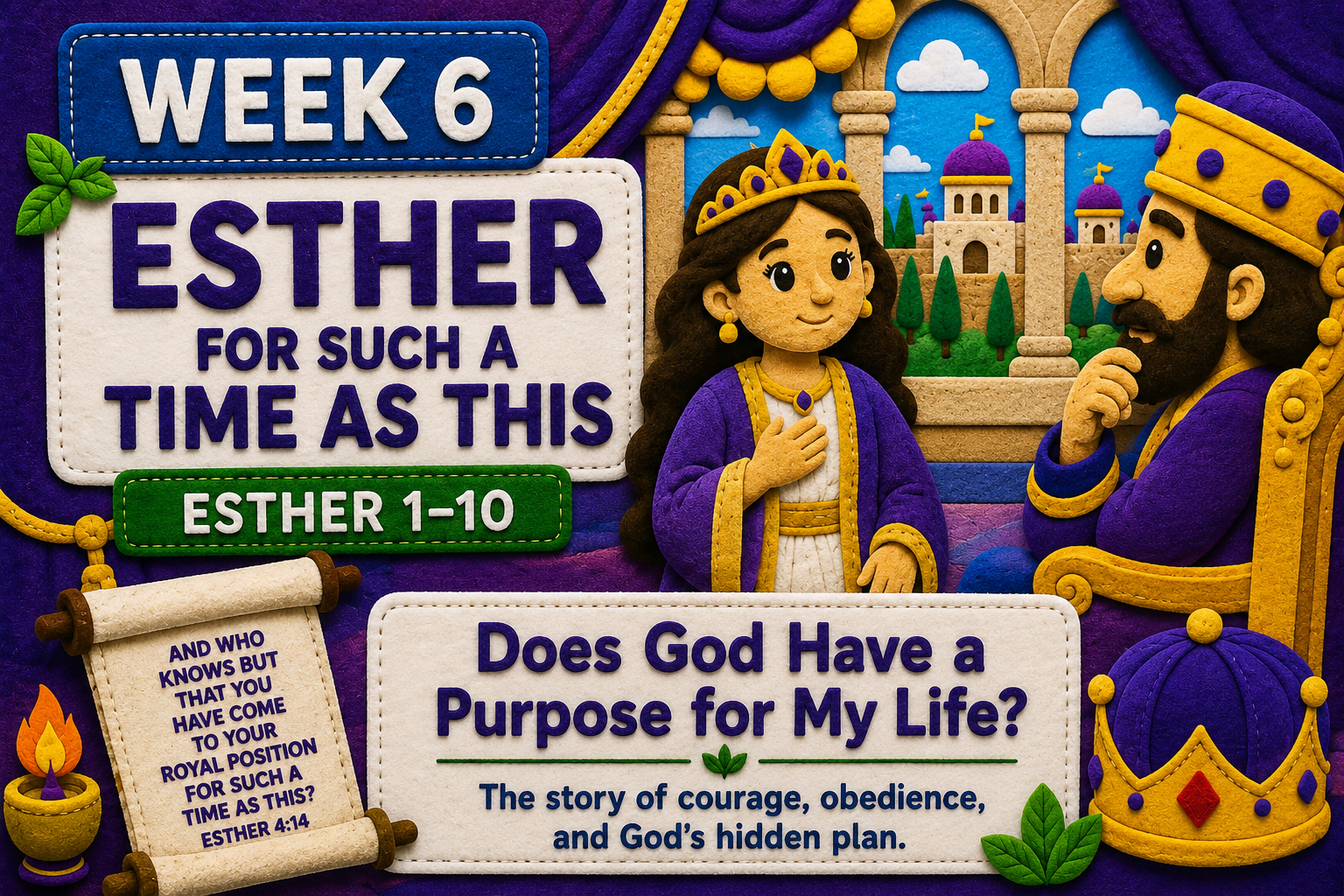
Week 6
Esther 1-10
-
Read: Esther 1:1–4; 2:5–18
"Who knows if perhaps you were made queen for just such a time as this?" — Esther 4:14
There are seasons in life when God seems unusually quiet. You pray, but the answers don't come as quickly as you hoped. You search the Scriptures for direction, yet the path ahead still feels uncertain. You know God is faithful, but you cannot always see what He is doing.
The book of Esther was written for moments like these. One of Esther's most remarkable features is that God's name never appears. There are no recorded miracles, no prophets, and no dramatic displays of divine power. At first glance, it almost seems as though God is absent from the story.
Yet His hand is everywhere.
The story unfolds far from Jerusalem, where many Jews still lived after the Babylonian exile. Among them was Esther, an orphan raised by her cousin Mordecai. Through a series of ordinary events, she was brought into the king's palace and chosen to become queen.
Nothing about those events appeared miraculous. A queen was removed. A young woman was chosen. A king made a decision. But behind every ordinary circumstance stood the providence of God.
Long before anyone realized it, God was arranging people, places, and events to preserve His people and accomplish His purposes.
That is often how God works in our lives. We look for dramatic miracles, yet He frequently guides us through everyday conversations, unexpected opportunities, closed doors, and delayed answers. Looking back, we discover that He was directing our steps all along.
The absence of visible miracles does not mean the absence of God's activity. Even when heaven seems silent, God has not stepped away from the story. He is working with perfect wisdom and perfect timing, accomplishing His purposes in ways we cannot yet see.
Faith & Facts: Why Isn't God's Name Mentioned in Esther?
Esther is unique because it never explicitly mentions God, prayer, worship, or the temple. Rather than highlighting God's miraculous intervention, the book emphasizes His providence. Through ordinary events and human decisions, God faithfully preserves His covenant people. His name never appears, but His sovereign hand is evident on every page.
Reflect
Have there been seasons when God seemed silent in your life?
Looking back, can you now see ways He was working behind the scenes?
How does trusting God's unseen providence change the way you face your current circumstances?
Prayer
Father, thank You that Your silence is never the same as Your absence. Help me trust that You are working even when I cannot see the full picture. Strengthen my faith to rest in Your wisdom, Your timing, and Your unfailing faithfulness. In Jesus' name, amen. -
Read: Esther 2:19–23; 3:1–15
"But Mordecai had discovered a plot..." — Esther 2:22 (NLT)
Life often feels like a series of unrelated events.
An unexpected conversation, a closed door, a new opportunity, or a disappointing setback can seem random at the time. Yet the story of Esther reminds us that God is often accomplishing His greatest work through ordinary circumstances.
Near the end of Esther 2, Mordecai uncovered a plot to assassinate King Xerxes. He reported it through Esther, the king's life was spared, and the event was recorded in the royal records. Then...nothing happened. Mordecai received no reward, and the story moved on.
That forgotten act of faithfulness would later become one of the most important turning points in the entire book.
Soon afterward, Haman was promoted to power. When Mordecai refused to bow before him, Haman's anger grew into a plan to destroy every Jew throughout the Persian Empire.
From a human perspective, everything appeared to be falling apart. In reality, God had already been preparing the answer before the crisis began. Esther's position as queen, Mordecai's integrity, and even an overlooked entry in the king's records were all part of His sovereign plan.
The same is true in our lives. We often want immediate explanations for unanswered prayers, unexpected disappointments, and closed doors. Yet God rarely reveals His entire plan at once. Instead, He calls us to trust His character while He unfolds His purposes.
Looking back, we often discover that what seemed like an interruption was actually preparation. What looked like coincidence was the quiet providence of God.
Nothing catches Him by surprise. Nothing falls outside His care. Nothing in the life of His children is ever wasted.
Faith & Facts: What Does "Providence" Mean?
Providence describes God's continual work of preserving, guiding, and directing His creation according to His purposes. Unlike a miracle, which is extraordinary, providence usually works through ordinary people, everyday decisions, and seemingly routine events. Esther beautifully demonstrates that God is always at work, even when His hand is unseen.
Reflect
Can you think of a time when a disappointment later became part of God's plan?
Where are you tempted to demand immediate answers instead of trusting God's wisdom?
How does knowing God is sovereign over ordinary events encourage you today?
Prayer
Father, thank You that nothing in my life is beyond Your control. Even when I cannot understand what You are doing, help me trust that You are faithfully working for Your glory and my good. Give me patience to wait on Your timing and confidence that You never waste a single detail of my life. In Jesus' name, amen. -
Read: Esther 4:1–17
"Who knows if perhaps you were made queen for just such a time as this?" — Esther 4:14 (NLT)
The crisis that had been building throughout the story finally reached Esther's doorstep. When Mordecai learned of Haman's decree, he mourned openly. Across the Persian Empire, Jewish families wept, fasted, and grieved because a day had been set for their destruction. Mordecai urged Esther to go before the king and plead for her people.
It was an extraordinary request. Persian law prohibited anyone from approaching the king without an invitation. The penalty was death unless the king extended his golden scepter. Esther had not been summoned for thirty days, and she knew entering the throne room could cost her life.
Mordecai challenged her with words that have echoed through the centuries: "Who knows if perhaps you were made queen for just such a time as this?"
He wasn't suggesting that everything in Esther's life pointed to one dramatic moment. He was reminding her that God had been working long before the crisis appeared. The events that once seemed ordinary had prepared her for this opportunity to trust Him.
God often works the same way in our lives. We want Him to reveal the entire plan before asking us to obey. Instead, He calls us to trust Him one step at a time. As we follow Him, we often discover that He has been preparing us through experiences, relationships, and seasons we didn't fully understand.
Esther's response reveals the heart of genuine faith: "If I must die, I must die." Those were not words of despair but of surrender. Esther entrusted the outcome to God and chose obedience over self-preservation.
That kind of courage is still needed today. We may never stand before a king, but we are called to speak the truth, love sacrificially, forgive freely, and obey God when it would be easier to remain comfortable.
God has placed each of us where we are for a reason. The opportunities before us today are not accidents. They are invitations to trust the God who has been faithfully writing our story all along.
Faith & Facts: Was Esther Wrong to Hide Her Jewish Identity?
The Bible tells us that Mordecai instructed Esther not to reveal her Jewish identity when she entered the palace (Esther 2:10), but it does not evaluate that decision. Instead, the book emphasizes God's providence. Through imperfect people living in difficult circumstances, God faithfully accomplished His purposes. Esther's story reminds us that God delights in using willing people who trust Him.
Reflect
What opportunity has God placed before you that requires courage?
Is fear keeping you from obeying something God has already made clear?
How does remembering God's faithfulness strengthen your confidence today?
Prayer
Father, thank You for working in my life even when I cannot see the whole picture. Give me the courage to obey You when it would be easier to remain comfortable. Help me trust that You have placed me where I am for Your purposes and that my future rests securely in Your hands. In Jesus' name, amen. -
Read: Esther 5:1–8; 6:1–14
"That night the king had trouble sleeping..." — Esther 6:1 (NLT)
Some of the greatest turning points in Scripture begin with the most ordinary moments. Esther 6 opens with a sentence that hardly seems important: "That night the king had trouble sleeping."
Unable to rest, King Xerxes ordered the royal records to be read aloud. As they were read, he discovered that Mordecai had once uncovered a plot to assassinate him, yet had never been rewarded.
At that very moment, Haman arrived at the palace. He had come to ask permission to execute Mordecai. Before he could speak, the king asked, "What should I do to honor a man who truly pleases me?"
Certain the honor was meant for himself, Haman described an elaborate public celebration. Instead, the king instructed him to do every one of those things for Mordecai.
Only God could orchestrate a story like that. A sleepless night. An old record book. A forgotten act of faithfulness. A perfectly timed arrival. None of those events appeared miraculous, yet together they revealed God's providence.
That is often how God works.
We tend to look for dramatic miracles, but He is just as active through delayed answers, unexpected conversations, inconvenient interruptions, and perfectly timed opportunities. We usually recognize His hand only after we look back.
When God seems silent, He is not inactive.
While Esther and Mordecai slept, the Lord was already arranging tomorrow's deliverance. He had not forgotten His people, and He has not forgotten you.
God never sleeps, never overlooks a detail, and never arrives too late. Even when you cannot trace His hand, you can trust His heart. He is faithfully accomplishing His purposes according to His perfect wisdom and timing.
Faith & Facts: Was It Really Just a Sleepless Night?
From a human perspective, King Xerxes simply couldn't sleep. Esther records no miracle or supernatural interruption. That is precisely the point. God's providence usually works through ordinary circumstances. Proverbs 21:1 reminds us that "The king's heart is like a stream of water directed by the Lord." Even a sleepless night was under God's sovereign control.
Reflect
Have you ever realized later that an inconvenience was actually God's provision?
Where are you tempted to mistake God's silence for His absence?
How does God's providence give you confidence to trust Him today?
Prayer
Father, thank You that You are always at work, even when I cannot see it. Help me trust that You are directing every detail of my life with perfect wisdom and love. Teach me to rest in Your providence, knowing that nothing is beyond Your control. In Jesus' name, amen. -
Read: Esther 7:1–10; 8:1–8
“If I have found favor with the king... let my life and the lives of my people be spared.” — Esther 7:3 (NLT)
The tension that had been building throughout Esther reaches its climax at the king's banquet. Esther reveals Haman's plot, identifies herself as one of those marked for death, and pleads for her people. Haman's evil is exposed, justice is carried out, and the Jewish people are given a way to defend themselves.
Although God's name is never mentioned, His faithfulness is evident throughout the story. He preserved His covenant people and protected the family through whom the promised Messiah would come.
Yet Esther's courage points us to someone even greater. Esther risked her life by entering the king's presence to plead for her people. Jesus did far more. He willingly gave His life to save His people. Esther interceded before an earthly king whose favor was uncertain. Jesus intercedes before the Father as the perfect Son whose sacrifice fully satisfied God's justice.
That is why our hope ultimately rests in Christ, not Esther. She reminds us that God works through ordinary people. Jesus accomplished the salvation that no ordinary person ever could.
Like Esther, we often cannot see the full story while we are living it. God calls us to trust Him one step at a time. Looking back, we discover that His hand was guiding us all along.
The cross and the empty tomb assure us that even when circumstances seem darkest, God is accomplishing something greater than we can see. Our calling is not to understand every detail of His plan, but to trust the One who is writing it.
Faith & Facts: Is the Book of Esther Historically Reliable?
Although some critics question Esther because it never mentions God, the book demonstrates remarkable knowledge of Persian customs, royal procedures, and court life—details that have been confirmed by archaeology and ancient historical sources.
More importantly, Esther fits seamlessly within God's unfolding plan of redemption, showing how He preserved the Jewish people until the coming of Jesus Christ. Its central message is clear: God is faithfully at work even when His hand is unseen.
Reflect
Where have you recognized God's providence only after looking back?
What circumstances are you finding difficult to trust Him with today?
How does knowing that Jesus intercedes for you strengthen your confidence in God's care?
Prayer
Father, thank You for Your faithful hand that guides my life even when I cannot see what You are doing. Thank You for preserving Your people and fulfilling every promise through Jesus Christ. Help me trust Your providence when life feels uncertain and give me the courage to obey You one step at a time. May my confidence rest in Your perfect wisdom, Your unfailing love, and the Savior who gave His life so that I might have eternal life. In His name, amen.
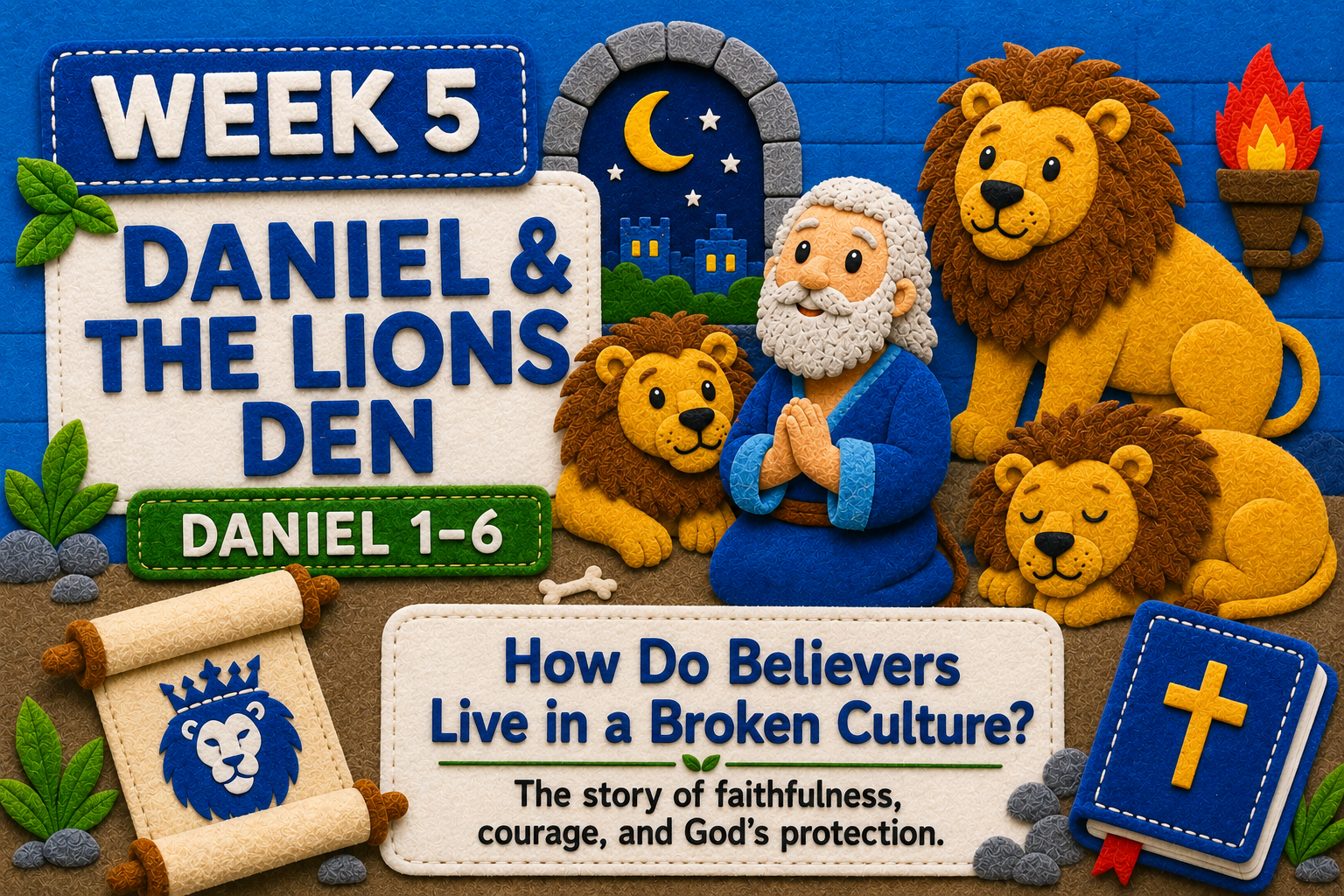
Week 5
DAniel & the Lions’ den: Daniel 1-6
-
Read: Daniel 6:1–10
"But when Daniel learned that the law had been signed, he went home and knelt down as usual... He prayed three times a day, just as he had always done." Daniel 6:10 (NLT)
Daniel's story didn't begin in the lions' den. It began decades earlier when he was taken captive to Babylon.
Far from home and surrounded by a culture that rejected the God of Israel, Daniel faced constant pressure to compromise. Yet through changing kings, shifting governments, and nearly seventy years of exile, one thing never changed—his devotion to the Lord.
By the time we reach Daniel 6, his enemies desperately wanted to remove him from office. But after examining his life, they found no corruption, dishonesty, or negligence. Their only accusation was this: Daniel was too faithful to God.
What a testimony. Daniel didn't withdraw from Babylon, nor did he become like Babylon. He served with excellence while remaining loyal to the Lord above all else.
Jesus prayed the same for His followers. He did not ask the Father to remove us from the world, but to keep us faithful as we live in it (John 17:15–18).
That calling hasn't changed. We are called to love our neighbors, serve our communities, and work with integrity, while remembering that our ultimate allegiance belongs to God's kingdom.
Daniel's courage in the lions' den began long before the lions arrived. It was the result of a lifetime of faithfully honoring God in everyday life.
Faith & Facts: Did Daniel Really Live in Babylon?
Both the Old and New Testaments present Daniel as a real historical person. Ezekiel mentions him alongside Noah and Job as an example of righteousness (Ezekiel 14:14), and Jesus referred to "Daniel the prophet" when speaking about future events (Matthew 24:15).
Archaeology has also confirmed many details about the Babylonian and Persian empires described in the book. Daniel's account is rooted in real history and points us to the God who remains faithful in every generation.
Reflect
How would others describe your character?
Would your daily life reveal a consistent devotion to Christ?
Where is God calling you to remain faithful, even when it's unpopular?
Prayer
Father, thank You for Daniel's example of steadfast faith. Help me live with integrity, serve others well, and remain faithful to You no matter what culture around me believes. May my life consistently reflect the character of Christ. In His name, amen. -
Read: Daniel 6:10–13
"He prayed three times a day, just as he had always done." Daniel 6:10 (NLT)
When King Darius signed the decree, Daniel knew exactly what it meant. Anyone who prayed to anyone other than the king would be thrown into the lions' den.
Daniel's response was remarkably ordinary. He went home, opened his windows toward Jerusalem, knelt down, and prayed—just as he had always done.
Daniel didn't become a man of prayer because of the crisis. The crisis simply revealed the habits he had built over many years. The same is true for us.
Faith is rarely formed in dramatic moments. It grows through daily time with God, consistent obedience, and quiet dependence on Him. When trials come, those habits become the foundation that steadies our hearts.
Daniel also gave thanks while facing an uncertain future. He didn't know whether God would rescue him from the lions, but he knew God was worthy of his trust.
That kind of confidence doesn't come from knowing the outcome. It comes from knowing the Lord. As we walk with Him day after day, our faith becomes steady enough to stand when it is tested.
Faith & Facts: Why Did Daniel Pray Facing Jerusalem?
Daniel prayed toward Jerusalem because he trusted God's covenant promises. When Solomon dedicated the temple, he prayed that God would hear His people if they turned toward Jerusalem while living in exile (1 Kings 8:46–50). Daniel wasn't trusting a direction. He was trusting the God who always keeps His promises.
Reflect
What daily habits are shaping your walk with God?
If your faith were tested today, what spiritual disciplines would strengthen you?
How can you make time with God a consistent part of each day?
Prayer
Father, thank You for the example of Daniel's faithful prayer life. Teach me to seek You daily, not only in times of trouble. Build in me a steady faith that is rooted in Your Word, strengthened through prayer, and confident in Your promises. Whatever today brings, help me walk closely with You. In Jesus' name, amen. -
Read: Daniel 6:14–23
“May your God, whom you serve so faithfully, rescue you.” Daniel 6:16 (NLT)
Daniel spent a lifetime doing what was right, yet that faithfulness led him to a place no one would choose.
The officials who opposed him had succeeded in their plan. The law could not be changed, and even King Darius, who respected Daniel deeply, was powerless to reverse his own decree. With great reluctance, the king ordered Daniel to be thrown into the lions’ den.
As the stone was rolled across the entrance, Darius spoke one final sentence: “May your God, whom you serve so faithfully, rescue you.”
Those words reveal something remarkable. Even a pagan king recognized that Daniel’s life had been marked by unwavering devotion to God.
What strikes me most about this moment is what Daniel didn’t say. He didn’t argue. He didn’t panic. He didn’t demand that God explain why this was happening.
Scripture records no speech, no protest, and no attempt to defend himself. Daniel had already made his decision long before he reached the lions’ den. He would obey God and leave the outcome in God’s hands.
That kind of faith is both simple and profound. We often obey God because we believe it will produce the outcome we want. We assume that if we are faithful, life will become easier, prayers will be answered the way we hope, and difficulties will quickly disappear. Sometimes that happens. Sometimes it doesn’t.
The Bible never promises that obedience will spare us from hardship. In fact, many of God’s most faithful servants walked through suffering, imprisonment, rejection, and even death.
What the Bible does promise is that God will never abandon His people. Daniel entered the lions’ den alone, but he was not alone.
During the night, God sent His angel and shut the mouths of the lions. When the king hurried to the den the next morning, he found Daniel alive. It wasn’t because Daniel had discovered some secret to surviving lions. It was because God had chosen to display His power and His faithfulness.
Yet we should be careful not to draw the wrong conclusion. The lesson isn’t that God always rescues His people from suffering. The lesson is that God is always present with His people in suffering.
Sometimes He delivers us from the fire. Sometimes He walks with us through the fire. Either way, He remains faithful. Our confidence has never rested in knowing what God will do. It rests in knowing who God is.
Faith & Facts: Did God Really Shut the Lions’ Mouths?
Some have suggested that the lions weren’t hungry or that Daniel survived because of some natural explanation. But the text leaves little room for that conclusion.
The next morning, Daniel testified that “My God sent His angel to shut the lions’ mouths” (Daniel 6:22). Later, when the conspirators were thrown into the den, the lions attacked them immediately, demonstrating that the animals were neither tame nor inactive.
The Bible presents Daniel’s deliverance as a miracle. Miracles are not violations of nature. They are acts of the God who created nature and rules over it. The God who made the lions was fully able to restrain them.
Reflect
· When have you found yourself wanting to control the outcome instead of simply obeying God?
· How would your life change if your first concern was faithfulness rather than comfort?
· What situation do you need to place into God’s hands today?
Prayer
Father, thank You that my future is secure in Your hands. Forgive me for the times I have allowed fear to control my decisions instead of trusting Your promises. Teach me to obey You regardless of the outcome, knowing that Your presence is enough. Whether You deliver me from difficulty or walk with me through it, help me rest in the confidence that You are always faithful. In Jesus’ name, amen. -
Read: Daniel 6:24–28
“For He is the living God, and He will endure forever. His kingdom will never be destroyed, and His rule will never end.” Daniel 6:26 (NLT)
When King Darius arrived at the lions’ den the morning after Daniel had been thrown inside, he wasn’t expecting good news. The law of the Medes and Persians could not be changed, and no one survived a night with hungry lions. As he called out into the darkness, his words revealed both hope and uncertainty: “Daniel, servant of the living God! Was your God, whom you serve so faithfully, able to rescue you from the lions?”
The answer that came back changed everything. Daniel was alive.
The lions had not harmed him because God had protected him throughout the night. The miracle was undeniable, but what happened next is just as significant. King Darius responded by issuing a decree that was sent throughout his kingdom, declaring the greatness of Daniel’s God. The king described Him as “the living God,” whose kingdom would never be destroyed and whose rule would never come to an end.
That response reminds us that Daniel’s story was never just about Daniel.
God did not preserve Daniel simply so he could live a few more years. He preserved him so that an entire empire would hear about the greatness of the God Daniel served. What began as a plot to silence one faithful believer became an opportunity for God’s name to be proclaimed throughout the kingdom.
That has always been God’s pattern. Throughout Scripture, He often works in and through the faithfulness of ordinary people so that others will come to know Him. Joseph’s integrity in Egypt pointed Pharaoh toward God’s wisdom. Esther’s courage preserved God’s people. Paul remained faithful in prison, and even members of Caesar’s household heard the gospel. Again and again, God uses the lives of His people to reveal His character to the world.
The same is true today. We may never stand before kings or face a den of lions, but someone is always watching the way we live. Our families watch how we respond to disappointment. Our coworkers notice whether our integrity matches our words. Our neighbors observe how we treat people, especially those who disagree with us. We often think our greatest witness comes from what we say, but many times it comes from how we live.
That doesn’t mean we live perfectly. It means we live faithfully. There is a quiet but powerful testimony in a life that consistently reflects the character of Christ. When people see peace in the middle of hardship, integrity when compromise would be easier, and hope that cannot be explained by circumstances alone, they begin to ask questions that point beyond us to the God we serve.
Jesus told His followers, “Let your good deeds shine out for all to see, so that everyone will praise your heavenly Father” (Matthew 5:16). Notice where the attention ultimately belongs. The goal of the Christian life is never to make much of ourselves. It is to make much of God.
Daniel understood that. He never sought recognition or influence for its own sake. He simply remained faithful where God had placed him. The Lord took that ordinary faithfulness and used it to make His name known throughout an entire empire.
Perhaps that is exactly what God wants to do through us. We may never realize the full impact of a life lived in quiet obedience, but God delights in using faithful people to point others to Himself.
Faith & Facts: Did King Darius Become a Believer?
The Bible tells us that Darius publicly acknowledged the greatness of Daniel’s God, but it never clearly says that he became a worshiper of the Lord. Like many rulers in the ancient world, he recognized God’s power without necessarily abandoning every other belief he held.
The focus of the story is not the king’s personal conversion but God’s public glory. Daniel’s faithfulness caused a pagan ruler to acknowledge that the God of Israel is the living God whose kingdom will never end. Once again, the book of Daniel reminds us that God’s purposes extend far beyond the lives of His servants. He is always at work revealing Himself to the nations.
Reflect
· Who has God placed in your life that is watching the way you follow Christ?
· In what area do you need to reflect His character more faithfully?
· How could your response to today’s circumstances become an opportunity to point someone to Jesus?
Prayer
Father, thank You for the example of Daniel’s faithful life. Help me remember that my daily choices matter because they reflect something about You to the people around me. Give me integrity when no one is watching, courage when obedience is difficult, and humility so that my life always points beyond myself to Christ. May others see Your goodness through the way I live today. In Jesus’ name, amen. -
Read: Daniel 6:19–23; Colossians 2:13–15
"My God sent His angel to shut the lions' mouths so that they would not hurt me." Daniel 6:22
The story of Daniel in the lions' den reminds us that God is able to rescue His people.
At daybreak, King Darius rushed to the lions' den, hoping against hope that Daniel's God had done the impossible. When Daniel answered from inside the den, the king's grief turned to joy. God had preserved His faithful servant.
It is a remarkable display of God's power, but the story points beyond itself to an even greater rescue. Throughout the Old Testament, God repeatedly delivers His people, preparing us to recognize the ultimate Deliverer when He comes.
Daniel's experience contains remarkable parallels to the life of Jesus. Both were innocent men, targeted by jealous enemies and handed over to governing authorities despite having done nothing deserving punishment. Both were sealed behind a stone while others believed their story had come to an end.
Yet the greatest lesson is found in their difference.
Daniel was rescued from death. Jesus willingly entered death.
God sent His angel to shut the mouths of the lions, but He did not spare His own Son from the cross. Jesus bore the judgment Daniel escaped because He came to bear the punishment our sins deserved. What appeared to be defeat became the greatest victory in history when Christ rose from the dead.
That is why our hope rests not in Daniel's deliverance but in Christ's resurrection. Daniel's rescue preserved one faithful servant for a few more years. Jesus' resurrection secured eternal life for all who trust Him.
This also shapes the way we face our own trials. God does not always deliver His people from suffering as He delivered Daniel. Throughout history, many faithful believers have endured persecution and even death for the sake of Christ. Yet their hope was never in escaping hardship. Their hope was in the risen Savior.
Because Jesus conquered sin and death, nothing—not suffering, not persecution, not even death itself—can separate us from His love or steal the inheritance He has promised.
Daniel's story calls us to admire God's faithfulness. Jesus' story calls us to worship the God who rescues sinners through His Son.
Faith & Facts: Did Jesus Believe Daniel Was a Historical Person?
Jesus referred to "Daniel the prophet" (Matthew 24:15), treating both Daniel and his writings as historical and authoritative. For Jesus, Daniel was not a fictional hero but a real servant of God whose life and prophecies pointed forward to God's unfolding plan of redemption.
Because Jesus affirmed Daniel, we can read this account with confidence, knowing that the God who rescued Daniel is the same God who accomplished our salvation through Christ.
Reflect
How does Daniel's rescue deepen your appreciation for Christ's resurrection?
Are you trusting God only when He changes your circumstances, or because of who He is?
How does Christ's victory give you hope in the challenges you face today?
Prayer
Father, thank You that every page of Scripture points me to Jesus. Thank You for preserving Daniel and revealing Your power through his life. Most of all, thank You for sending Your Son to accomplish the rescue I could never accomplish for myself. Help me trust You whether You deliver me from hardship or sustain me through it, knowing that because Christ is risen, my hope is secure. May my life always point others to the Savior who has conquered sin and death. In His name, amen.
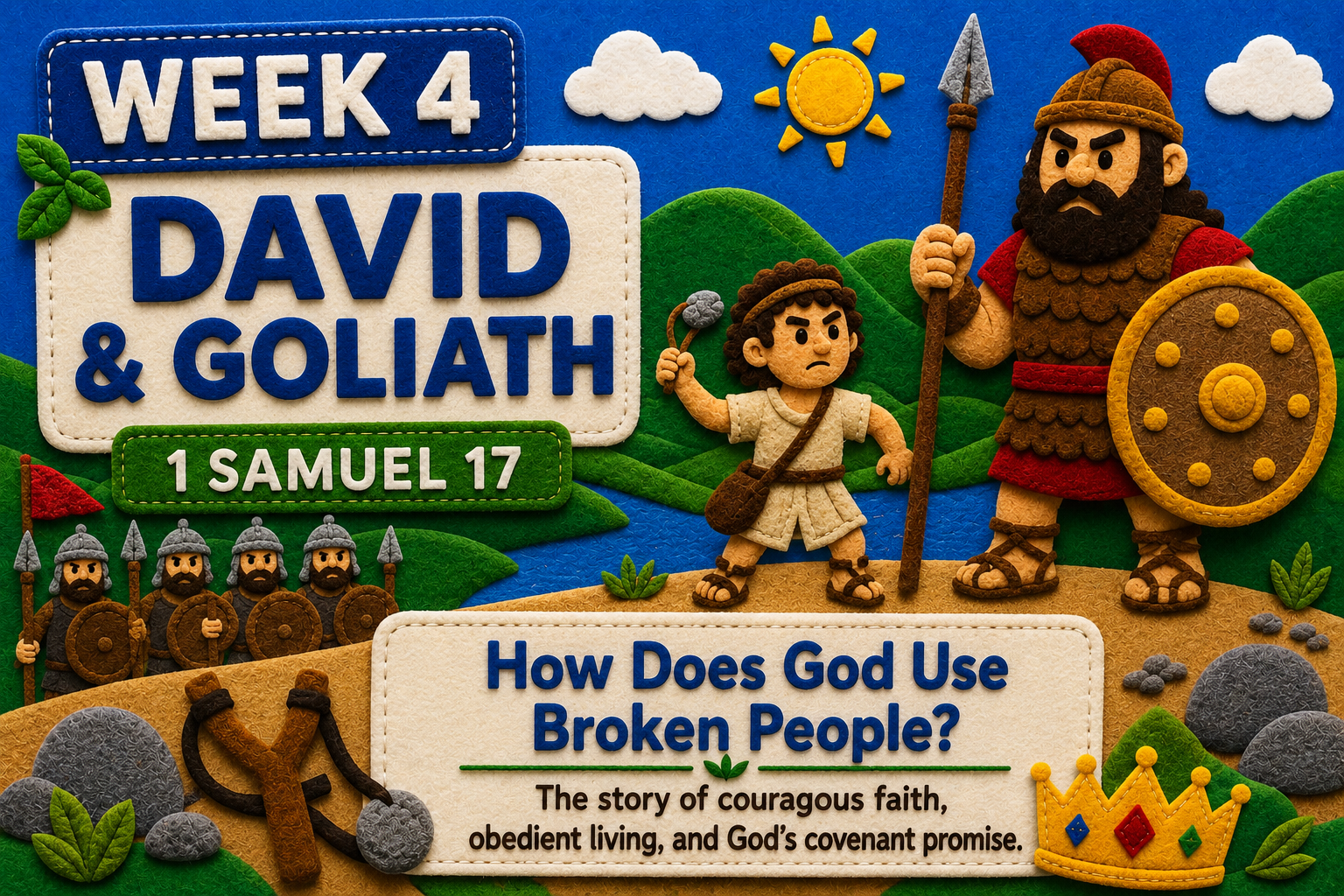
Week 4
DAVID & GOliath: 1 Samuel 17
-
Read: 1 Samuel 17:1–11, 32–37
“The battle is the Lord's…” 1 Samuel 17:47 (NLT)
The story of David and Goliath is often told as an underdog story—a reminder to "face your giants." While that application has value, it isn't the main point of the passage.
When David arrived at the Valley of Elah, he found Israel's army paralyzed by fear. For forty days Goliath had challenged God's people, and for forty days no one stepped forward. From a human perspective, their fear made sense. Goliath was an experienced warrior, heavily armed, and seemingly invincible.
David saw the same giant everyone else saw, but he viewed the battle through a different lens. The soldiers focused on the size of their enemy. David focused on the greatness of God.
Goliath wasn't simply defying Israel—he was defying the living God. David believed that the Lord was more than able to defend His own name, and that confidence transformed fear into faith.
We face battles of our own. Illness, financial pressure, broken relationships, anxiety, and uncertainty can easily dominate our thoughts. The longer we focus on our circumstances, the larger they appear.
Faith doesn't deny reality. It places reality beneath the greater reality of God's character.
David's courage did not come from believing in himself. It came from believing in the God who had never failed His people. The same is true today. Our circumstances may change, but God's power, faithfulness, and presence never do. Whatever battle lies before you, remember that the Lord is greater than the giant.
Faith & Facts: Was Goliath Really a Giant?
Some question whether Goliath's size has been exaggerated, but the biblical account fits the historical setting of the Philistines. Ancient sources describe unusually large warriors, and although scholars debate Goliath's exact height because of differences in ancient manuscripts, they agree he was an exceptionally intimidating opponent.
The point of the account has never been Goliath's measurements. Scripture presents an impossible obstacle so that God's power—not David's ability—receives the glory.
Reflect
What challenge has occupied your thoughts lately?
Have you been focusing more on the size of your problem than the greatness of God?
What truth about God's character do you need to remember today?
Prayer
Father, thank You for reminding me that You are greater than anything I will face today. Forgive me for allowing fear to shape my thinking instead of trusting Your promises. Lift my eyes from the size of my problems to the greatness of Your character, and strengthen my faith to walk confidently with You. In Jesus' name, amen. -
Read: 1 Samuel 17:32–37
“The Lord who rescued me from the claws of the lion and the bear will rescue me from this Philistine!” 1 Samuel 17:37 (NLT)
When David volunteered to fight Goliath, King Saul could hardly believe it. David was young, while Goliath was a seasoned warrior. Humanly speaking, the outcome seemed certain.
But David's confidence was not rooted in his own ability. Instead, he remembered God's faithfulness.
As a shepherd, David had faced lions and bears while protecting his father's sheep. Those victories happened far from the spotlight, but they became the training ground for his faith. Each rescue reminded David that the Lord could be trusted.
God was preparing David long before he ever stood in the valley. The same is true for us. God often uses ordinary seasons to prepare us for future challenges. Quiet acts of obedience, unseen faithfulness, and daily dependence on Him shape our character in ways we may not recognize until much later.
When we pause to remember God's faithfulness, we discover that He has been at work all along—providing, strengthening, guiding, and sustaining us through every season.
Remembering yesterday's faithfulness gives us confidence for today's battle. The God who carried you through yesterday has not changed. His promises remain true, and His grace is sufficient for whatever lies ahead.
Faith & Facts: Was David Just a Lucky Shepherd?
Ancient shepherds often became highly skilled with a sling, and a stone launched at high speed could be a powerful weapon.
Yet David never credited his skill for the coming victory. He declared, "The Lord...will rescue me."
Scripture doesn't ignore David's preparation—it simply points beyond it. David faithfully used the abilities God had given him while depending completely on the God who gave them.
Preparation matters, but our confidence ultimately rests in the Lord.
Reflect
Where have you seen God's faithfulness in your life?
How does remembering His past provision strengthen your faith today?
What ordinary act of obedience might God be using to prepare you for the future?
Prayer
Father, thank You for Your faithfulness throughout my life. Help me remember the many ways You have carried and sustained me. Strengthen my faith as I recall Your goodness, and prepare me through today's obedience for whatever You have planned tomorrow. In Jesus' name, amen. -
Trust the God Who Goes With You
Read: 1 Samuel 17:38–47
“The battle is the Lord's, and He will give you to us!” 1 Samuel 17:47 (NLT)
Before David entered the valley, Saul offered him his own armor. It was a generous gift and seemed like the best way to prepare for battle. David tried it on but quickly realized he couldn't fight in equipment he had never used. The issue wasn't simply that the armor didn't fit. It represented two very different ways of viewing the battle.
Saul trusted what human strength could provide. David trusted the God who had been with him long before he ever faced Goliath.
As a shepherd, David had learned that God's presence was enough. The Lord had protected him from lions and bears, and David believed He would remain faithful in the valley.
We often respond like Saul. When facing challenges, we naturally look for something that makes us feel secure—our experience, our resources, our plans, or the approval of others. While those things have value, they were never meant to replace our dependence on God.
Our confidence is not found in what we possess but in the One who goes with us.
Jesus gave His followers that same assurance before ascending to heaven: "I am with you always, even to the end of the age" (Matthew 28:20).
That promise changes everything. We may not know how God will work, but we never face life's battles alone. His presence is our greatest source of strength.
Faith & Facts: Why Didn't David Wear Saul's Armor?
David rejected Saul's armor because he was not accustomed to fighting in it. Throughout the chapter, his confidence rested not in better equipment but in God's faithfulness.
The contrast is intentional. Saul looked to human resources, while David trusted the Lord. God often works through ordinary people who depend on Him rather than extraordinary people who depend on themselves.
Reflect
Where are you tempted to rely on your own strength instead of God's?
How has God's presence sustained you in past seasons?
What would change if you consciously remembered today that the Lord is with you?
Prayer
Father, thank You that my confidence rests in Your presence, not in my own strength. Forgive me for relying on what I can control instead of trusting You. Remind me that You go before me, walk beside me, and never leave me. Help me face every challenge with confidence because You are with me. In Jesus' name, amen. -
The Battle Was Never About David
Read: 1 Samuel 17:48–54
“Today the Lord will conquer you… and the whole world will know that there is a God in Israel.” 1 Samuel 17:46 (NLT)
Everything about the battle appeared to favor Goliath. He was larger, stronger, better equipped, and far more experienced. David carried only a sling, a staff, and five smooth stones.
Before David ever released a stone, he explained why the battle mattered: "You come to me with sword, spear, and javelin, but I come to you in the name of the Lord of Heaven's Armies."
David understood that this was never about proving himself. Goliath had defied the living God, and the Lord was about to display His power so that everyone would know He alone gives victory.
When David's stone struck the giant, the outcome changed instantly. Israel's army, once frozen by fear, advanced in confidence because God had defeated their enemy. David's victory points beyond itself.
Just as David stood as Israel's representative against an enemy the people could not defeat, Jesus came as our representative to conquer the enemies we could never overcome. Through His death and resurrection, Christ defeated sin, Satan, and death, winning a victory we receive by faith rather than achieve through our own efforts.
Our lives are not about proving our strength or protecting our reputation. They are about making God's greatness known. As we trust Him, He works through ordinary people so that the glory belongs to Him alone.
Faith & Facts: Did David Kill Goliath with One Stone?
Ancient slingers were capable of remarkable accuracy, and a stone launched at high speed could be deadly. Scripture doesn't ignore David's skill, but it makes clear that skill alone was not the reason for Israel's victory.
David declared, "The battle is the Lord's." God used David's abilities, but the victory belonged to Him. Throughout Scripture, God delights in displaying His power through people who trust Him.
Reflect
What battle are you tempted to face in your own strength?
How would your perspective change if your greatest desire were God's glory rather than your own success?
How does Jesus' victory over sin and death encourage you today?
Prayer
Father, thank You that You are the One who gives victory. Forgive me for the times I focus more on my own abilities than on Your power. Help me live for Your glory and trust that You can accomplish Your purposes through ordinary people who depend on You. Thank You that through Jesus Christ the greatest battle has already been won. In His name, amen. -
Read: Romans 5:6–11; Colossians 2:13–15
"But God showed His great love for us by sending Christ to die for us while we were still sinners." Romans 5:8 (NLT)
When we read the story of David and Goliath, it's natural to picture ourselves as David. We want to be courageous, trust God, and face life's giants with confidence. Those are worthwhile lessons, but they aren't the greatest message of the story.
The Israelites standing on the hillside were powerless against Goliath. They needed someone to fight on their behalf. Their future depended entirely on whether a champion would step into the valley and win the battle they could never win themselves.
That points us directly to Jesus. Like Israel, we face an enemy we cannot defeat on our own. Our greatest enemies are sin and death. No amount of determination, morality, or religious effort can overcome them.
So God sent a Champion. Jesus entered the battle for us. He lived the sinless life we could never live and willingly gave His life on the cross in our place. What looked like defeat became the greatest victory in history. Through His death and resurrection, Jesus conquered sin, defeated death, and broke Satan's power over all who trust Him.
David's victory brought temporary deliverance to Israel. Christ's victory brings eternal salvation to everyone who believes.
That's why the story of David and Goliath is ultimately not about becoming more like David. It is first about trusting the greater David.
Only after we have placed our faith in Christ can we live with the courage David displayed. We no longer fight for victory—we live from the victory Jesus has already won.
The Christian life is not about trying harder to overcome every giant in our own strength. It is about trusting the Savior who has already conquered our greatest enemy.
That is the hope of the gospel.
Faith & Facts: Does the Bible Really Point to Jesus?
After His resurrection, Jesus met two disciples on the road to Emmaus. Beginning with Moses and all the Prophets, "He explained to them what was said in all the Scriptures concerning Himself" (Luke 24:27).
David was a real shepherd, king, and man of faith, but his life also pointed forward to the coming Messiah. Just as David represented Israel against Goliath, Jesus became our representative by defeating sin and death on our behalf.
The Bible is one unified story that finds its fulfillment in Christ.
Reflect
How does knowing Jesus has already won the greatest victory change the way you face today's challenges?
Are you striving to earn God's acceptance, or are you resting in Christ's finished work?
Who could you encourage this week with the hope of the gospel?
Prayer
Father, thank You for sending Jesus to do what I could never do for myself. Thank You that through His death and resurrection, He defeated sin, death, and the power of the enemy. Help me live each day from His victory rather than striving in my own strength. May my confidence rest in Christ alone, and may my life point others to the Savior who has conquered every enemy. In His name, amen.
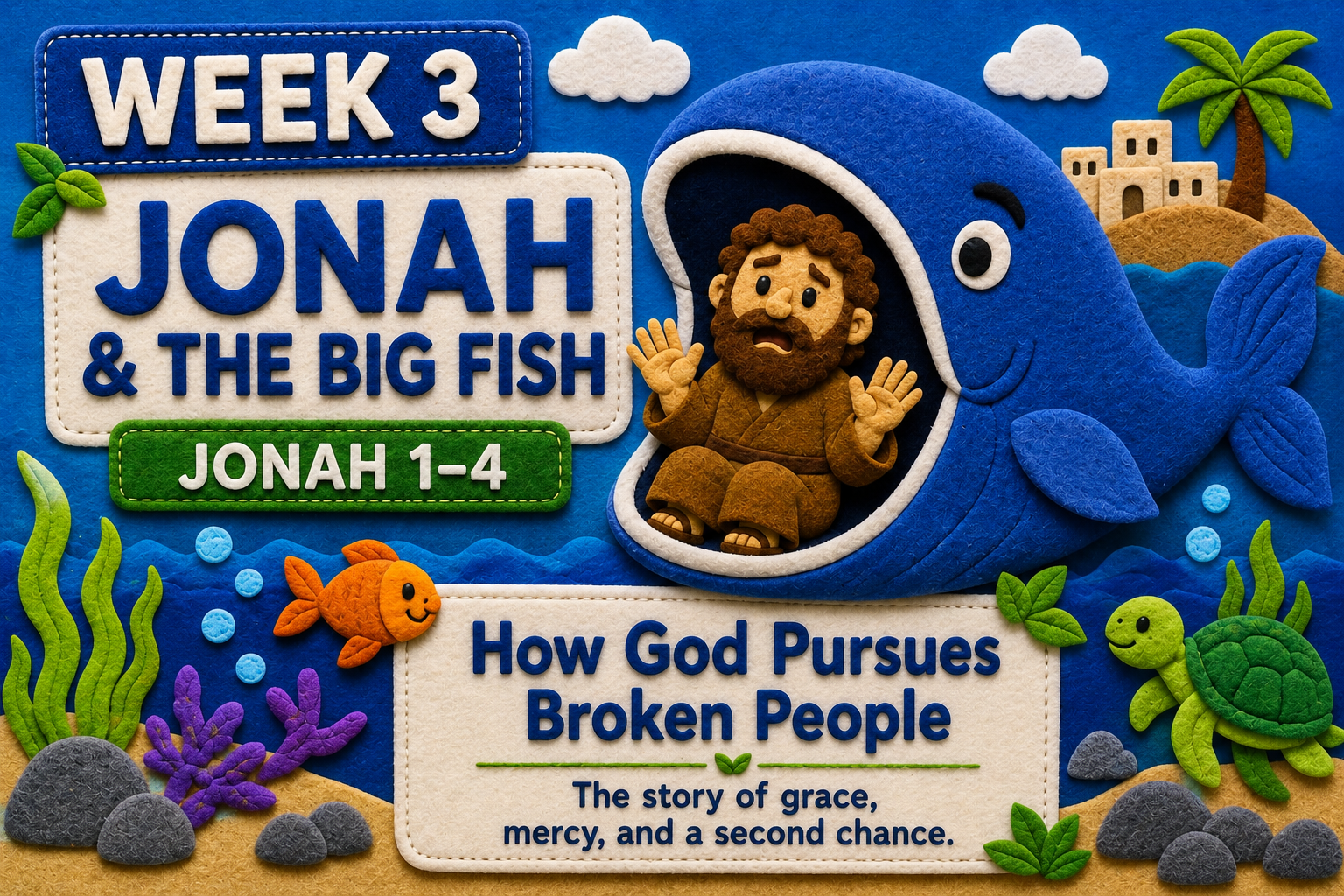
Week 3
jonah & the big Fish: jonah 1-4
-
Read: Jonah 1:1–6
“The Lord gave this message to Jonah… ‘Get up and go to the great city of Nineveh. Announce My judgment against it because I have seen how wicked its people are.’ But Jonah got up and went in the opposite direction…” Jonah 1:1–3 (NLT)
God called Jonah to go to Nineveh, the capital of one of the most violent empires in the ancient world. Instead of obeying, Jonah headed in the opposite direction.
His response wasn't driven by fear of failure but by resistance to God's mercy. Jonah knew the Lord was compassionate, and he didn't want the people of Nineveh to receive the grace he believed they didn't deserve. Yet God's command revealed His heart. He was giving a wicked city the opportunity to repent.
Jonah's story reminds us that running from God doesn't always look dramatic. Sometimes it is obvious disobedience. Other times it is quiet resistance. We delay forgiveness, ignore His prompting to serve, or postpone obedience because His plan feels uncomfortable. Left unchecked, reluctance becomes rebellion.
The remarkable part of Jonah's story is not that he ran, but that God pursued him. The Lord could have chosen another prophet, yet He refused to abandon Jonah. His pursuit was not driven by anger but by grace. God was determined to accomplish His purposes while restoring His servant.
The same God pursues us today. When He calls us to obey, it is never because He wants to make life harder. His commands are invitations to trust His wisdom, reflect His heart, and participate in His work. God's call may stretch our faith, but it will always lead us closer to Him.
Faith & Facts: Did Jonah Really Exist?
Scripture presents Jonah as a real prophet who ministered during the reign of King Jeroboam II (2 Kings 14:25). Jesus also referred to Jonah as a historical person, pointing to Jonah's three days in the great fish as a foreshadowing of His own death, burial, and resurrection (Matt. 12:39–41). Jonah's account is more than an inspiring story. It is part of God's unfolding plan of redemption, pointing us to Christ.
Reflect
Is there an area of your life where you've been resisting God's direction?
Why can obedience sometimes feel difficult, even when we know God is trustworthy?
How does God's pursuit of Jonah encourage you today?
Prayer
Father, thank You for never giving up on me. Forgive me for the times I have resisted Your voice or delayed my obedience. Give me a heart that responds quickly when You speak and help me trust that Your plans are always better than my own. Thank You for pursuing me with grace even when I have wandered. May my life reflect joyful obedience to Your call. In Jesus' name, amen. -
Read: Jonah 1:4–17
“Meanwhile, the Lord hurled a powerful wind over the sea, causing a violent storm that threatened to break the ship apart.” Jonah 1:4 (NLT)
Jonah believed that distance could free him from God's call. Instead of traveling east to Nineveh, he boarded a ship bound for Tarshish, hoping to leave God's assignment behind.
We may never board a ship to escape God's will, but we often try to outrun His voice in quieter ways. We fill our schedules, distract our minds, or convince ourselves that a change of circumstances will solve what is really a matter of the heart.
Changing our location never changes God's presence. As Jonah sailed farther from home, God sent a violent storm. While experienced sailors fought to save the ship, Jonah slept below deck. When the sailors discovered that Jonah's disobedience was the cause of their trouble, he confessed that he worshiped "the Lord, the God of heaven, who made the sea and the land."
The irony is unmistakable. Jonah was trying to flee from the very God who ruled the sea beneath the ship. David later declared, "I can never escape from Your Spirit! I can never get away from Your presence!" (Psalm 139:7). For those who belong to God, that truth is not frightening—it is deeply comforting. His presence means we are never abandoned, and His love means we are never beyond His reach.
The storm was not evidence that God had rejected Jonah. It was evidence that God loved him too much to let him keep running. Sometimes God's greatest mercy is refusing to leave us where we are. Through His loving discipline, He calls us back to Himself so we can experience the joy of walking in His will.
Faith & Facts: Did God Really Send the Storm?
Scripture makes it clear that God sent the storm (Jonah 1:4), but His purpose was restoration, not destruction. The storm exposed Jonah's disobedience, redirected his heart, and introduced the sailors to the true God.
God's discipline is an expression of His love. He often uses difficult circumstances to draw His children back to Himself and accomplish His greater purposes.
Reflect
Is there an area of your life where you've been avoiding God's direction?
Have you experienced a difficult season that ultimately drew you closer to the Lord?
How does God's constant presence encourage you today?
Prayer
Father, thank You that there is nowhere I can go beyond Your presence. Even when I wander, You continue to pursue me with grace and truth. Help me stop running from Your voice and begin trusting Your heart. Give me the courage to surrender every area of my life to You, knowing that Your plans are always better than my own. In Jesus' name, amen. -
Read: Jonah 2:1–10
“Then Jonah prayed to the Lord his God from inside the fish.” Jonah 2:1 (NLT)
Jonah had reached the end of himself. Only a short time earlier, he had been running from God. Now he sat in complete darkness, fully aware that his life was beyond his own control. It was not where Jonah wanted to be, but it was where God began to change him.
Throughout Scripture, God often does His deepest work in life's hardest places. Moses met Him in the wilderness. David learned to trust Him while hiding in caves. Paul discovered God's strength through weakness. Now Jonah encountered God's mercy from inside a great fish.
The turning point in Jonah's story was not his location—it was his heart. For the first time, he stopped running and started praying.
Hard seasons have a way of stripping away our self-sufficiency. Pride gives way to dependence, distractions lose their grip, and we are reminded that our hope has always rested in God alone.
Jonah discovered that God's discipline was never meant to destroy him but to restore him. The fish was not evidence that God had abandoned His prophet. It was God's gracious provision to preserve his life and lead him to repentance.
From the depths of the sea, Jonah confessed, "Salvation comes from the Lord alone!" (Jonah 2:9).
That remains the heart of the gospel. We cannot rescue ourselves. Salvation has always been God's work from beginning to end, fully accomplished through Jesus Christ.
Faith & Facts: Could Someone Really Survive Inside a Great Fish?
From a human perspective, surviving three days inside a great fish is impossible. Scripture presents it as exactly what it is—a miracle. Jonah 1:17 emphasizes that "the Lord had arranged" for the fish, directing our attention to God's power rather than the biology of the animal.
Jesus treated Jonah's experience as a real historical event and used it to foreshadow His own death and resurrection (Matthew 12:40). The greatest miracle is not simply that Jonah survived, but that God graciously refused to let his rebellion have the final word.
Reflect
Has God ever used a difficult season to deepen your faith?
Is there an area of your life where God is inviting you to surrender instead of striving?
What would it look like to turn to God in prayer today?
Prayer
Father, thank You for never giving up on me. Even when I wander, You continue to pursue me with mercy. Help me trust that You are at work even in difficult seasons. Teach me to pray before I panic, surrender before I strive, and remember that salvation comes from You alone. Thank You for being the God of second chances. In Jesus' name, amen. -
Read: Jonah 3:1–10; 4:1–4
“When God saw what they had done and how they had put a stop to their evil ways, He changed His mind and did not carry out the destruction He had threatened.”
Jonah 3:10 (NLT)After three days inside the fish, Jonah received what he never deserved—a second chance. God gave him the same assignment He had given before: go to Nineveh. This time, Jonah obeyed.
Nineveh was the capital of the Assyrian Empire, a nation known for violence and cruelty. If any city seemed beyond hope, it was this one.
Yet when Jonah proclaimed God's warning, the people responded with genuine repentance. From the king to the common citizen, they humbled themselves before the Lord, confessed their sin, and cried out for mercy.
God answered with mercy. Surprisingly, the only person unhappy with that outcome was Jonah.
He admitted that he had run because he knew God's character. The Lord is "merciful and compassionate, slow to get angry and filled with unfailing love" (Jonah 4:2). Jonah wanted that mercy for himself but not for his enemies.
His struggle exposes a temptation we all face. We gladly receive God's grace, yet we can hesitate to celebrate it when it reaches people we consider undeserving.
The gospel leaves no room for that attitude. Every one of us stands in need of the same mercy. None of us earns God's forgiveness, and none of us is beyond His reach. At the cross, Jesus took the judgment our sin deserved so that anyone who repents and believes can be forgiven.
God's mercy is always greater than our prejudice, and His grace is greater than our worst failures.
Faith & Facts: Did God Change His Mind?
Jonah 3:10 says that God did not bring the judgment He had announced, but this does not mean His character changed. Scripture consistently teaches that God is unchanging (Malachi 3:6; James 1:17).
God's warnings are invitations to repentance. When the people of Nineveh turned from their sin, they experienced the mercy God had always promised to those who repent. His justice remained constant, and so did His grace.
Reflect
Is there anyone you struggle to believe could receive God's grace?
Why is it sometimes easier to receive mercy than to celebrate it for others?
How should God's forgiveness shape the way you treat those around you?
Prayer
Father, thank You for showing mercy to me when I deserved judgment. Forgive me for the times pride, prejudice, or bitterness have kept me from loving people as You do. Give me Your heart for those who are far from You. Help me celebrate Your grace wherever it is received and faithfully share the hope of Jesus with everyone I meet. In His name, amen. -
Does Your Heart Look Like God's?
Read: Jonah 4:5–11
“Shouldn't I feel sorry for such a great city?” Jonah 4:11 (NLT)
Most stories end by answering every question. Jonah ends by asking one.
After Nineveh repented, Jonah left the city and waited, hoping God would still bring judgment. Instead, God used a simple object lesson to reveal what was happening in Jonah's heart.
The Lord caused a leafy plant to grow, giving Jonah shade from the scorching sun. Jonah was grateful for the plant, but when God allowed it to wither, Jonah became angry.
Then God exposed the contrast.
Jonah grieved over a plant that had benefited him for a single day, yet he showed no compassion for more than 120,000 people who were spiritually lost.
So God asked, "Shouldn't I feel sorry for such a great city?"
The book ends there, inviting every reader to answer that question personally.
It is easy to celebrate God's mercy when it reaches people like us. It is much harder when it reaches those we dislike, misunderstand, or consider undeserving. Yet the gospel reminds us that none of us deserved God's grace. Every one of us has sinned, and every one of us needed God's mercy.
The cross reveals the heart of God. Jesus willingly bore the judgment our sins deserved so that anyone who repents and believes can be forgiven. His love reaches farther than our prejudice, our preferences, and our boundaries.
Jonah wanted God to change Nineveh. God wanted to change Jonah.
He still works the same way today. As we grow in Christ, He shapes our hearts to love what He loves and to carry His message of hope to a world that desperately needs Him.
Faith & Facts: Did Nineveh's Repentance Last?
The people of Nineveh genuinely repented during Jonah's ministry, and God withheld the judgment He had announced (Jonah 3:10). Many years later, however, a new generation returned to violence and rebellion, and the prophet Nahum proclaimed Nineveh's destruction.
Their story reminds us that every generation must respond to God for itself. Faith cannot be inherited. Each person is called to repent and place their trust in the Lord.
Reflect
Is there someone you find difficult to view with God's compassion?
Who has God placed in your life that needs to hear the hope of the gospel?
In what ways is God shaping your heart to become more like His?
Prayer
Father, thank You for loving me when I was far from You. Forgive me for the times pride, fear, or prejudice have kept me from loving others as You do. Give me Your heart for those who are lost, and help me faithfully share the hope of Jesus wherever You send me. In His name, amen.
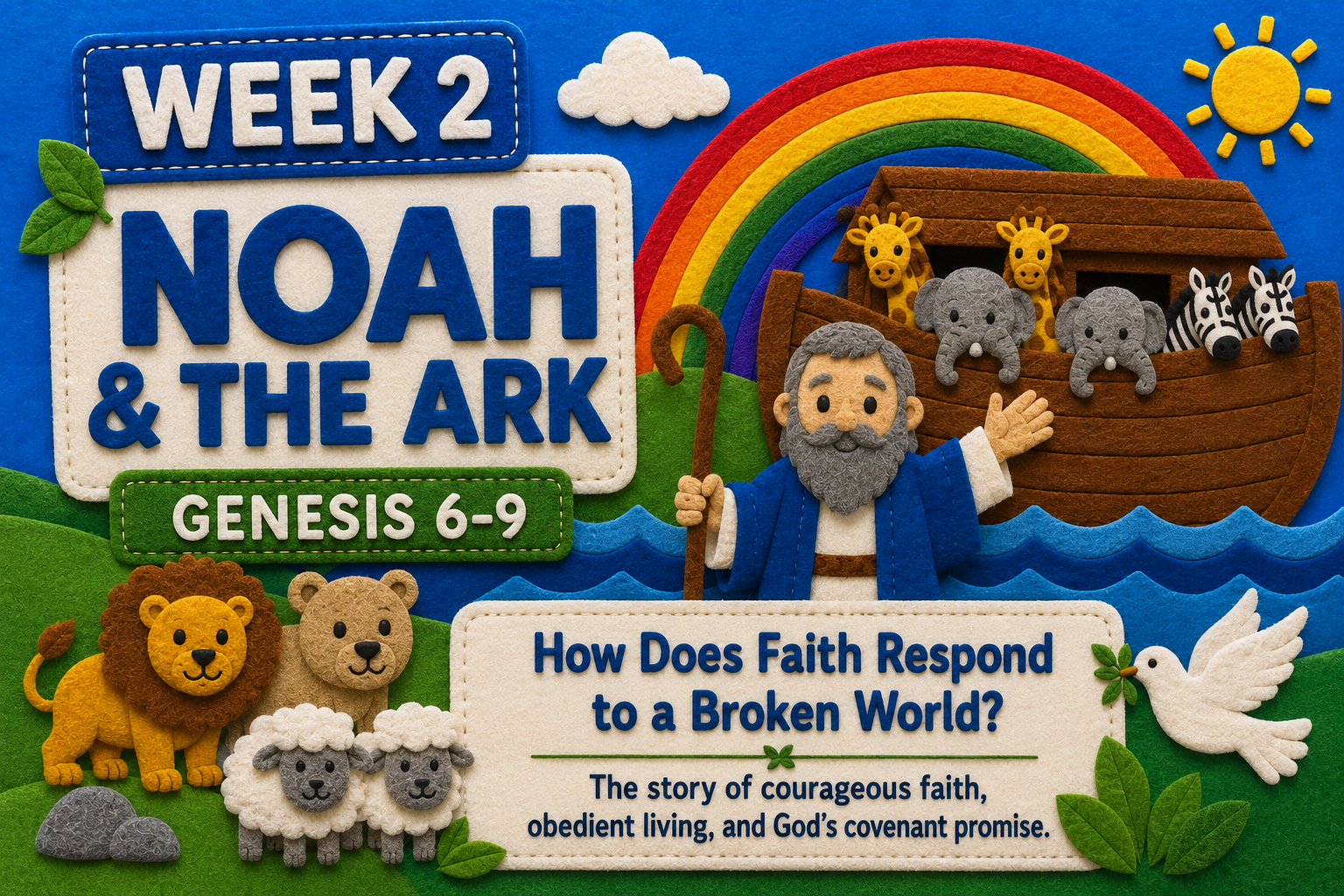
Week 2
Noah & the Ark: Genesis 6-9
-
Read: Genesis 6:5–9
“But Noah found favor with the Lord.”
Genesis 6:8 (NLT)The story of Noah is often remembered for an ark filled with animals, but its focus is much greater. It reveals God's character and shows what faith looks like in a world shaped by sin.
By Noah's day, humanity had become deeply corrupt. Violence filled the earth, and every inclination of the human heart was bent toward evil. The effects of Adam and Eve's rebellion had spread through every part of society, leaving God's good creation scarred by sin.
Then one sentence changes everything: "But Noah found favor with the Lord."
That favor was God's grace—His undeserved kindness. Noah's righteousness was not something he earned to gain God's acceptance; it was the fruit of a life that trusted God. His faith was expressed through obedience.
When God told Noah to build an ark, there was no visible evidence that a flood was coming. Noah simply believed God's Word. Year after year, as he built the ark, every board and every hammer strike declared that God's promises could be trusted, even when no one else believed.
That is the nature of biblical faith. Faith is not blind optimism or wishful thinking. It is confident obedience based on the character of God. It trusts His Word before seeing the outcome.
God still calls His people to that kind of faith. We obey when forgiveness is difficult, remain faithful when obedience is costly, and trust His promises when the future is uncertain. Like Noah, we may not know where obedience will lead, but we know the One who calls us.
Jesus is the perfect example of faithful obedience. He trusted the Father's plan completely, and through His obedience He became the source of salvation for all who place their faith in Him.
Faith & Facts: Did Noah Really Exist?
Scripture consistently presents Noah as a real historical person. Jesus compared the days before His return to the days of Noah (Matthew 24:37–39). Hebrews lists Noah among the heroes of faith (Hebrews 11:7), and Peter refers to him as a preacher of righteousness (1 Peter 3:20; 2 Peter 2:5).
Christianity is rooted in God's real acts in history. The God who preserved Noah is the same God who fulfilled His promise of redemption through Jesus Christ.
Reflect
Where is God calling you to trust Him before you can see the outcome?
What circumstances tempt you to rely on your own understanding instead of God's promises?
What step of obedience is God asking you to take today?
Prayer
Father, thank You for showing me what genuine faith looks like through Noah's life. Teach me to trust Your Word even when I cannot see what You are doing. Strengthen my faith to obey You with confidence, knowing that Your plans are always good. May my life point others to You as I walk faithfully with Christ. In Jesus' name, amen. -
Read: Genesis 6:5–13
“The Lord observed the extent of human wickedness on the earth, and He saw that everything they thought or imagined was consistently and totally evil.”
Genesis 6:5 (NLT)The flood is one of the Bible's most challenging accounts because it confronts us with an important question: How can a loving God judge the world?
Genesis reveals that the flood was not God's first response to human sin. It was His final response after generations of persistent rebellion. Violence and corruption had become the defining marks of humanity, and God's good creation was being consumed by evil.
God's judgment was not a loss of self-control. It was the righteous response of a holy God who refuses to ignore sin.
We understand this instinctively. A judge who overlooks injustice is not compassionate—he is unjust. In the same way, God's love is never separated from His holiness. Because He loves what is good, He must also confront what destroys it.
Yet the flood is not only a story of judgment. It is also a story of mercy. Before the rain fell, God provided an ark. Before judgment came, He made a way of salvation. Even in His judgment, God preserved the family through whom His promise of redemption would continue.
This pattern reaches its fulfillment in Jesus Christ. At the cross, God's justice and mercy meet perfectly. Jesus bore the judgment our sin deserved so that everyone who trusts in Him can receive forgiveness and eternal life.
The flood reminds us that God's judgment is real. The cross reminds us that His grace is greater.
Faith & Facts: Was the Flood Local or Global?
Christians have held different views about the extent of Noah's flood. Some understand it as worldwide, while others believe it was a catastrophic regional event. We believe that the Bible teaches the flood was global, supported by the evidence. Regardless of that discussion, Scripture is clear about its purpose.
Jesus treated the flood as a real historical event (Matthew 24:37–39), and Peter pointed to it as evidence that God judges sin while preserving those who trust Him (2 Peter 3:5–7). The central message remains the same: God is holy enough to judge sin and gracious enough to provide salvation.
Reflect
How has this passage shaped your understanding of God's justice?
Why is it important that God's love and holiness are never separated?
How does the cross help you understand both God's judgment and His mercy?
Prayer
Father, thank You that Your love is perfectly joined with Your holiness. Thank You for providing a way of salvation through Jesus before judgment fell. Help me never to take Your grace for granted, but to live each day in gratitude for the mercy You have shown me through Christ. In His name, amen. -
Read: Genesis 8:1–19
“But God remembered Noah and all the wild animals and livestock with him in the boat. He sent a wind to blow across the earth, and the floodwaters began to recede.” Genesis 8:1 (NLT)
There is a sentence in the middle of Noah’s story that is easy to overlook.
In fact, if you were reading quickly, you might pass right over it.
“But God remembered Noah.”
At first, those words can sound strange. Did God actually forget Noah? Had He become so occupied with judging the earth that Noah slipped His mind?
Of course not.
When the Bible says that God “remembered,” it doesn’t mean He recalled something He had forgotten. It means He was about to act on behalf of His people. Throughout Scripture, God “remembers” when He moves to fulfill His promises.
He remembered Noah. He remembered Abraham. He remembered His covenant with Israel in Egypt. He remembered Hannah’s prayer. Each time, His remembrance led to His intervention. That truth must have meant everything to Noah.
Imagine what life was like inside the ark. The rain had stopped, but there was still no dry ground. Day after day the ark drifted across a world covered with water. Noah couldn’t see what was beneath him or what lay ahead. He had no map, no forecast, and no timeline. All he had was the promise God had made before the flood.
Have you ever felt like that? Maybe you’ve prayed for healing, but nothing has changed. Maybe you’ve asked God to restore a relationship, open a door, or provide direction, and the answer seems delayed.
Waiting is one of the hardest parts of the Christian life because we naturally want God to work according to our schedule. But God is never in a hurry, and He is never late. He is always accomplishing His purposes, even when we cannot yet see them.
Noah couldn’t control the flood. He couldn’t speed up the process. He couldn’t steer the ark. His responsibility was simply to trust the God who had already proven Himself faithful. That’s often our calling as well.
Faith doesn’t mean understanding every step of God’s plan. It means trusting His character when His plan is still unfolding.
Eventually, the waters began to recede. The mountains appeared. The door of the ark opened. Noah stepped onto dry ground and discovered that God had kept every promise He made.
He always does.
The same God who remembered Noah has not forgotten you. He sees your circumstances. He hears your prayers. He knows your fears. And at the right time, He will accomplish exactly what He has promised.
Faith & Facts: Did Noah Really Spend Over a Year on the Ark?
Many children’s books make it seem as though the flood lasted only a few weeks, but the biblical account tells a different story.
From the time Noah entered the ark until he stepped onto dry ground, more than a year had passed (Genesis 7–8). The rain itself lasted forty days and forty nights, but the waters remained on the earth for many months afterward.
Why does that matter? Because God wasn’t simply rescuing Noah from a storm. He was teaching Noah to trust Him through an extended season of waiting.
Sometimes we think faith is demonstrated in dramatic moments. More often, it’s revealed in ordinary days when we continue trusting God without seeing immediate results.
Noah’s greatest act of faith may not have been building the ark. It may have been patiently remaining inside until God said it was time to leave.
Reflect
• Where are you waiting on God today?
• How have you seen God’s faithfulness in previous seasons of your life?
• What promise from Scripture can encourage you while you wait?
Prayer
Father, thank You that You never forget Your children. Even when I cannot see what You’re doing, help me believe that You are working according to Your perfect wisdom and timing. Give me patience when the waiting feels long, courage when I feel discouraged, and confidence that You always keep Your promises. Help me rest in Your faithfulness today. In Jesus’ name, amen. -
Read: 1 Peter 3:18–22
“Christ suffered for our sins once for all time. He never sinned, but He died for sinners to bring you safely home to God.” 1 Peter 3:18 (NLT)
When Noah finally stepped out of the ark, the world had changed forever.
The flood was over. The judgment had passed. The family that emerged from the ark did so because God had faithfully preserved them through the storm. It was a new beginning, not because Noah had overcome the flood on his own, but because God had provided a way of rescue.
That raises an important question. Why does the New Testament spend so much time talking about Noah? Peter gives us the answer. He tells us that the story of Noah points beyond itself. It prepares us to understand something even greater. The ark wasn’t merely a boat. It was a picture of salvation.
Think about the story for a moment.
God warned that judgment was coming. He patiently gave Noah instructions for building the ark. He invited Noah and his family inside. Then God Himself shut the door. Everyone inside the ark was saved—not because they were better than everyone else, but because they trusted the provision God had made. The safety wasn’t found in Noah’s ability. It was found in God’s provision. The same is true of the gospel.
The greatest danger we face is not a flood but our sin. Left to ourselves, we cannot rescue ourselves. No amount of good works, religious activity, or personal effort can remove our guilt before a holy God.
So God did what only He could do. He sent His Son.
Jesus lived the perfect life we could never live. On the cross He took the judgment our sins deserved, and through His resurrection He opened the way to eternal life for everyone who believes in Him.
Just as Noah entered the ark by faith, we enter into God’s salvation by faith in Christ.
That doesn’t mean the ark saves us. It means the ark helps us understand the Savior. The rescue Noah experienced was temporary. Eventually, he would grow old and die. The rescue Jesus offers is eternal. He doesn’t simply preserve us through life’s storms. He delivers us from the power of sin, the fear of death, and the judgment to come. That’s why the story of Noah still matters. It reminds us that God has always been in the business of rescuing people. The ark was never the destination. It was always pointing us to Jesus.
Faith & Facts: Was There Really Only One Way to Be Saved?
One of the things that stands out in Genesis is that there was only one ark.
God didn’t tell Noah to build several boats and let people choose the one they preferred. He provided one way of rescue because there was one coming judgment.
Some people struggle with Jesus’ claim, “I am the way, the truth, and the life. No one can come to the Father except through Me” (John 14:6). They wonder why God would provide only one way of salvation.
The story of Noah helps us answer that question. The issue isn’t whether God provided many options. The issue is that He graciously provided any way at all.
Salvation has always been God’s gift, never humanity’s achievement. The wonder of the gospel isn’t that there’s only one Savior.
The wonder is that God loved us enough to send one.
Reflect
• What similarities do you see between Noah’s ark and God’s plan of salvation through Jesus?
• Have you been trusting in your own goodness, or are you resting completely in Christ?
• How does God’s provision of salvation deepen your gratitude for His grace?
Prayer
Father, thank You for providing what I could never provide for myself. Thank You for sending Jesus to bear my judgment and become my refuge. Help me never place my confidence in my own efforts but rest completely in the finished work of Christ. Fill my heart with gratitude for the grace You have shown me, and help me share that hope with others. In Jesus’ name, amen. -
Read: Genesis 9:8–17
“I have placed My rainbow in the clouds. It is the sign of My covenant with you and with all the earth.” Genesis 9:13 (NLT)
After stepping off the ark, Noah's first priority was not rebuilding his life—it was worship.
Having witnessed God's judgment and experienced His deliverance, Noah responded with gratitude. Worship was the natural response to God's faithfulness.
We often do the opposite. We celebrate God's provision briefly before turning our attention to the next challenge. Noah reminds us to pause and remember the God who has carried us through every storm.
In response to Noah's worship, God established a covenant with him and with every living creature. A covenant is more than a promise; it is a binding commitment rooted in God's unchanging character. Unlike human promises, God's faithfulness never depends on changing circumstances or emotions.
To remind every generation of that covenant, God placed a rainbow in the sky.
Whenever storm clouds give way to sunlight, the rainbow declares that God keeps His Word. It is not merely a symbol of hope after hardship but a reminder that the God who judges sin is also the God who faithfully extends mercy.
The covenant with Noah pointed forward to an even greater promise. Throughout Scripture, God continued revealing His plan until it reached its fulfillment in Jesus Christ. On the night before His crucifixion, Jesus spoke of the new covenant, established through His own blood (Luke 22:20).
The flood reminds us that God's judgment is real. The ark reminds us that God provides a place of rescue. The rainbow reminds us that God keeps every promise He makes.
All three find their fulfillment in Jesus. Just as Noah and his family were safe inside the ark, everyone who is in Christ is secure from the judgment sin deserves. At the cross, God's justice was satisfied, His mercy was displayed, and His covenant promises were forever secured.
Our confidence is not found in our ability to hold on to God, but in His unfailing faithfulness to hold on to us.
Faith & Facts: What Does the Rainbow Really Mean?
Long before the rainbow became associated with any cultural movement, God gave it as the sign of His covenant after the flood (Genesis 9:12–17). It reminds us that He is faithful to His promises and sovereign over His creation.
For Christians, the rainbow is first and foremost a testimony to God's character. Every rainbow points beyond itself to the God whose justice is perfect, whose mercy is abundant, and whose promises never fail.
Reflect
When you look back on your life, where have you seen God's faithfulness most clearly?
Which promise from God's Word do you need to hold on to today?
How can worship become your first response instead of your last resort?
Prayer
Father, thank You for being perfectly faithful in every generation. You have never failed to keep a single promise. Help me remember Your goodness in every season and respond with worship instead of worry. Thank You for the new covenant established through Jesus Christ and for the assurance that I am safe in Him. Strengthen my faith to trust Your promises every day. In Jesus' name, amen.
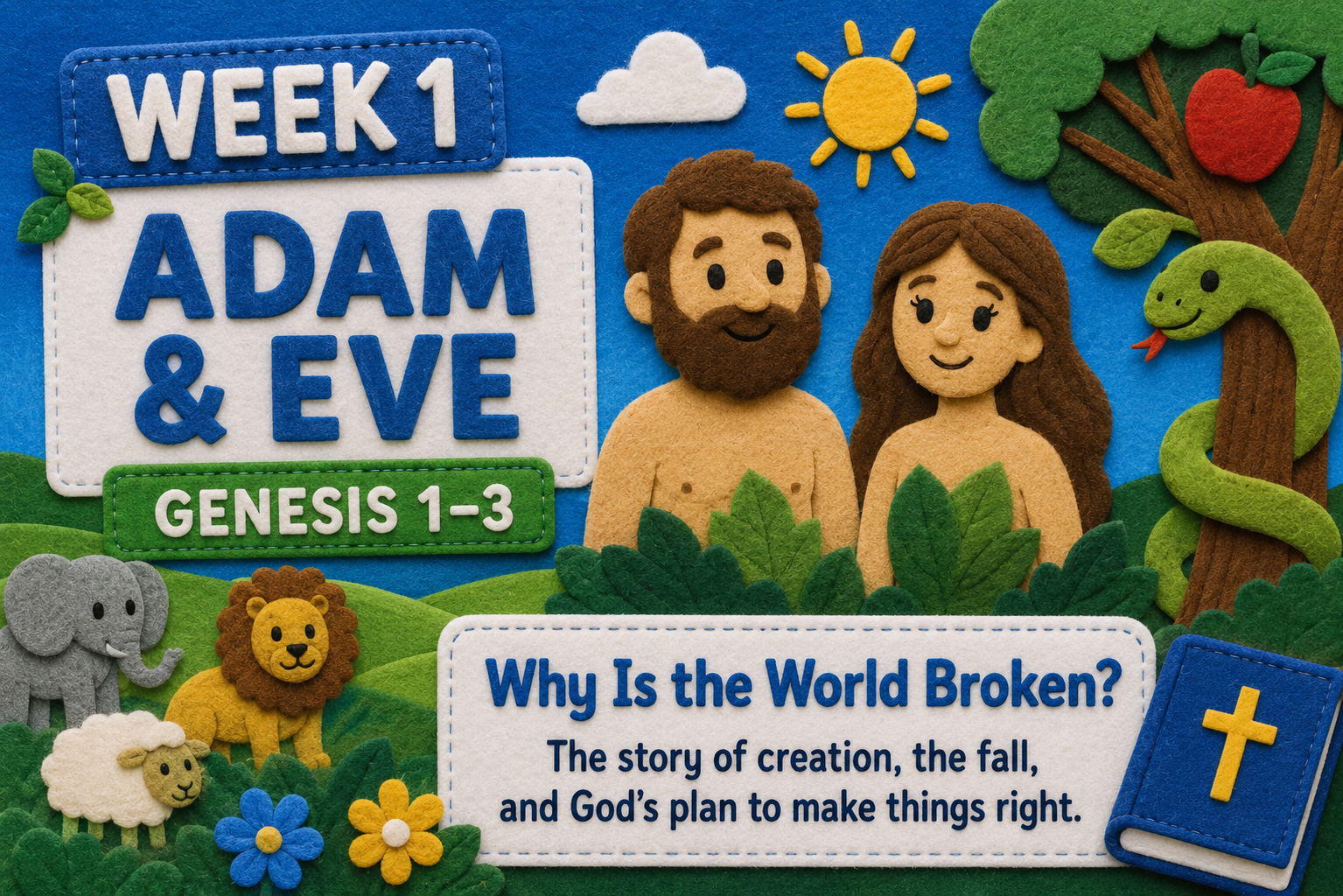
Week 1
Adam & Eve: Genesis 1-3
-
Read: Genesis 2:15–17; 3:1–13
“The Lord God placed the man in the Garden of Eden to tend and watch over it. But the Lord God warned him, ‘You may freely eat the fruit of every tree in the garden—except the tree of the knowledge of good and evil. If you eat its fruit, you are sure to die.’” Genesis 2:15–17 (NLT)
Our world bears the marks of brokenness everywhere we look. Headlines are filled with violence, families are fractured, hearts are burdened by grief, and every one of us experiences the effects of fear, failure, and loss. Deep down, we know life is not the way it was meant to be.
Genesis tells us why.
God created the world "very good." Adam and Eve enjoyed perfect fellowship with Him in a world free from fear, shame, conflict, sickness, and death. They had everything they needed and every reason to trust their Creator.
Yet God gave them a choice. In the middle of the Garden stood one tree they were not to eat from. The command was simple: trust God's wisdom rather than determine good and evil for themselves.
The serpent challenged that trust with a single question: "Did God really say?" Ever since, humanity has wrestled with the same temptation—to doubt God's goodness and believe we know better than He does.
When Adam and Eve disobeyed, sin entered the world. Their fellowship with God was broken. Innocence gave way to shame, peace to fear, and life to death. Every expression of brokenness we experience today traces back to humanity's rebellion against God.
Yet Genesis is also the beginning of hope. Before Adam and Eve left the Garden, God promised that a Savior would come to defeat sin and evil (Genesis 3:15). From the very beginning, His plan of redemption pointed to Jesus Christ.
The Bible doesn't simply explain what's wrong with the world—it reveals God's answer. Our greatest need is not better circumstances but a restored relationship with our Creator, and that restoration is found in Christ alone.
Faith & Facts: Was Adam a Real Person?
The Bible consistently presents Adam as a real historical person. Jesus referred to Adam and Eve when teaching about marriage (Matthew 19:4–6), and the apostle Paul built his explanation of sin and salvation on Adam's historical reality (Romans 5:12–21; 1 Corinthians 15:21–22, 45). Paul even calls Jesus the "last Adam," showing that Christ succeeded where the first Adam failed. The gospel begins with a real Fall and is fulfilled through a real Redeemer.
Reflect
Where do you see the effects of sin most clearly—in the world and in your own life?
Have you ever questioned God's goodness instead of trusting His wisdom?
How does God's promise of a Savior deepen your appreciation for Jesus?
Prayer
Father, thank You for revealing both the reality of our brokenness and the hope of redemption. Help me recognize my need for Your grace and trust that Your ways are always good. Thank You for promising a Savior from the very beginning and fulfilling that promise through Jesus Christ. Deepen my love for Him and my confidence in the truth of Your Word. In Jesus' name, amen. -
Read: Genesis 3:1–7
“Did God really say you must not eat the fruit from any of the trees in the garden?”
Genesis 3:1 (NLT)Every temptation begins with a question about whether God can be trusted.
The serpent did not begin by denying God's existence. Instead, he planted doubt: "Did God really say?" His goal was to undermine confidence in God's character. He wanted Eve to believe that God was withholding something good and that true freedom could only be found apart from Him.
That same lie continues today. Our culture often encourages us to define our own truth, follow our own hearts, and decide for ourselves what is right and wrong. God's commands are portrayed as restrictive rather than life-giving.
Genesis tells a different story. Before giving one command, God gave Adam and Eve abundant freedom. They could enjoy every tree in the Garden except one. His boundary was not intended to diminish their joy but to protect it and remind them that He alone is the source of truth and life.
Temptation still follows the same pattern. We focus on what God has withheld instead of the countless blessings He has provided. We begin to question His motives, and His loving boundaries start to feel like burdens. Left unchecked, that doubt leads us to place ourselves where only God belongs.
Adam and Eve's sin was more than eating forbidden fruit. They chose independence over trust and their own authority over God's.
Every day we face the same decision. Will we trust our own understanding, or will we trust the Lord? One voice promises independence but leads to brokenness. The other calls us to trust the God whose commands always flow from His perfect love.
Faith & Facts: Was the Serpent Really Satan?
While Genesis refers to the tempter as "the serpent," the rest of Scripture identifies him as Satan (Revelation 12:9). Jesus called the devil "a liar and the father of lies" (John 8:44), describing the very strategy we see in Eden. Satan rarely begins by denying truth outright. He begins by creating doubt about God's goodness, making it easier to reject God's Word.
Reflect
What voices have the greatest influence on the way you think about truth?
Have you ever viewed God's loving boundaries as unnecessary restrictions?
Where is God calling you to trust His Word instead of your own instincts?
Prayer
Father, thank You for giving me Your Word as a trustworthy guide. Forgive me for the times I've questioned Your goodness or relied on my own understanding. Help me recognize the lies that pull my heart away from You and give me the wisdom to stand firmly on Your truth. Teach me to trust that every command You give is an expression of Your perfect love. In Jesus' name, amen. -
Read: Genesis 2:15–17
“The Lord God placed the man in the Garden of Eden to tend and watch over it. But the Lord God warned him, ‘You may freely eat the fruit of every tree in the garden—except the tree of the knowledge of good and evil. If you eat its fruit, you are sure to die.’”
Genesis 2:15–17 (NLT)One of the most common questions about Genesis is why God placed the tree of the knowledge of good and evil in the Garden. If He knew Adam and Eve would sin, why give them the opportunity?
The answer reveals the kind of relationship God desires with His people.
God did not create robots programmed to obey Him. He created men and women in His image, capable of knowing Him, loving Him, and freely responding to His voice. Genuine love requires trust, and trust requires a choice.
Before giving one command, God gave Adam and Eve extraordinary freedom: "You may freely eat the fruit of every tree in the garden." His generosity far outweighed His restriction. The single boundary reminded them that they were created to live under God's loving authority, not to determine truth for themselves.
The tree represented a choice that every generation still faces: Will we trust God's wisdom, or will we define good and evil on our own?
Our culture celebrates independence and self-determination, but Scripture teaches that true freedom is found in trusting the One who created us. Jesus declared, "You will know the truth, and the truth will set you free" (John 8:32).
Freedom is not the absence of authority. It is the joy of living as God designed us to live. As we trust His Word and submit to His will, we discover the life He intended from the very beginning—a life that is fully restored through Jesus Christ.
Faith & Facts: Did God Cause Adam and Eve to Sin?
God's foreknowledge did not cause Adam and Eve's disobedience. Scripture teaches that God never tempts anyone to sin (James 1:13). Adam and Eve made a real choice and were fully responsible for it.
Even so, their rebellion did not catch God by surprise. Before the foundation of the world, He had already planned redemption through Christ (Ephesians 1:4–5; 1 Peter 1:19–20). The cross was never God's backup plan—it was His eternal plan to display both His justice and His grace.
Reflect
Have you ever viewed God's commands as limitations instead of loving protection?
Where are you tempted to define truth for yourself instead of trusting God's Word?
How does understanding God's desire for a genuine relationship shape your view of obedience?
Prayer
Father, thank You for creating me to know You, love You, and walk with You. Forgive me for wanting Your blessings without submitting to Your authority. Teach me to see Your commands as expressions of Your goodness, not restrictions on my joy. Help me trust that Your wisdom is always greater than my own, and shape my heart to delight in following You. Through Jesus Christ my Lord, amen. -
The God Who Comes Looking
Read: Genesis 3:8–15
“Then the Lord God called to the man, ‘Where are you?’”
Genesis 3:9 (NLT)Sin changed everything.
Adam and Eve, who had once walked freely with God, now hid from His presence. Shame replaced innocence, fear replaced peace, and the fellowship they had enjoyed with their Creator was broken.
Yet God did not abandon them. Instead, He came looking for them.
His first words were not words of condemnation but an invitation: "Where are you?" God already knew Adam's location. The question was meant to draw Adam out of hiding and into honest confession.
That is still God's heart today.
Our instinct after we sin is often to hide. We make excuses, shift blame, or distance ourselves from God because we assume He no longer wants us. But throughout Scripture, God is the One who takes the initiative. He called Abraham, pursued Moses, sent prophets to Israel, and ultimately sent His Son to seek and save the lost.
Jesus came for people who hide behind shame. Through His death and resurrection, the barrier of sin has been removed so that we can return to the Father with confidence. God's question to Adam echoes as an invitation of grace: Come out of hiding and come home.
Because of Christ, we never have to wonder whether God will receive us. He is already seeking us with mercy.
Faith & Facts: Did God Really Not Know Where Adam Was?
God's question, "Where are you?" was not a request for information but an invitation to repentance. Throughout Scripture, God asks questions to draw people to honest reflection and confession. He asked Cain about Abel (Genesis 4:9), and Jesus asked His disciples who they believed He was (Matthew 16:15). In each case, God knew the answer. His questions reveal His desire for relationship, not His lack of knowledge.
Reflect
When you fail, is your first instinct to run toward God or away from Him?
Are there areas of your life where you've been hiding instead of confessing your sin?
How does it encourage you to know that God takes the initiative to seek His people?
Prayer
Father, thank You that You never stop pursuing those You love. Thank You that even when I wander, You continue to call me back to Yourself. Forgive me for the times I've hidden behind shame instead of running to Your grace. Help me trust that because of Jesus, I can come boldly into Your presence, knowing I am welcomed, forgiven, and loved. In His name, amen. -
The Promise That Changed Everything
Read: Genesis 3:14–24
“And I will cause hostility between you and the woman, and between your offspring and her Offspring. He will strike your head, and you will strike His heel.” Genesis 3:15 (NLT)
If you were writing the story of humanity, Genesis 3 would seem like a terrible place to end. The first man and woman had rebelled against God. Sin had entered the world. The curse had begun. Paradise was lost. If the story ended there, the Bible would simply be a record of humanity’s greatest failure.
But before Adam and Eve ever left the Garden, God spoke words of hope.
As He pronounced judgment on the serpent, He made a promise. One day, a descendant of the woman would come. The serpent would wound Him, but He would ultimately crush the serpent’s head.
At first, those words seem mysterious. Yet as the rest of Scripture unfolds, they become clearer and clearer. The promised Deliverer would be born into the human family. He would suffer. He would be opposed by Satan. But through His suffering, He would win the decisive victory over sin, death, and the devil.
Christians have long referred to Genesis 3:15 as the Protoevangelium, a Latin word meaning “the first gospel.” It is the first announcement of God’s plan to save the world.
Think about what that means.
Before Adam and Eve could earn another chance, God promised a Savior.Before they could prove themselves, God extended grace. Before they walked out of Eden, God assured them that sin would not have the final word. That promise was fulfilled thousands of years later when Jesus Christ was born in Bethlehem.
On the cross, Satan bruised His heel. Jesus suffered, bled, and died. But three days later, the tomb was empty. Through His death and resurrection, Jesus crushed the power of sin, defeated death, and secured eternal victory for everyone who trusts in Him. Genesis begins with humanity hiding from God.The Gospels reveal God coming to humanity.Revelation ends with God dwelling forever with His redeemed people.
From beginning to end, the Bible tells one story. It is the story of a holy God who pursues sinful people with extraordinary grace. It is the story of Jesus.
Faith & Facts: Is Jesus Really Predicted in the Old Testament?
Some people assume Christians simply read Jesus back into the Old Testament. Yet Jesus Himself taught that the Scriptures pointed to Him.
After His resurrection, He walked with two discouraged disciples on the road to Emmaus. Luke tells us that, “Beginning with Moses and all the Prophets, He explained to them what was said in all the Scriptures concerning Himself” (Luke 24:27).
Genesis 3:15 is where that story begins. Throughout the Old Testament, God progressively reveals His plan through promises, sacrifices, covenants, kings, prophets, and symbols that all find their fulfillment in Christ. The Bible is not sixty-six disconnected books. It is one unified story with one central Hero.
Reflect
• How does Genesis 3:15 change the way you read the rest of the Bible?
• What does it mean to you that God promised a Savior before Adam and Eve ever left the Garden?
• Who in your life needs to hear the hope of the gospel this week?
Prayer
Father, thank You that You never abandoned humanity to sin and death. Thank You that before the consequences of the Fall fully unfolded, You had already promised a Redeemer. Thank You for sending Jesus to do what Adam could never do and to restore what sin had broken. Help me live each day with confidence in Your promises and gratitude for Your amazing grace. May my life point others to the hope that is found in Christ alone. In His name, amen.